
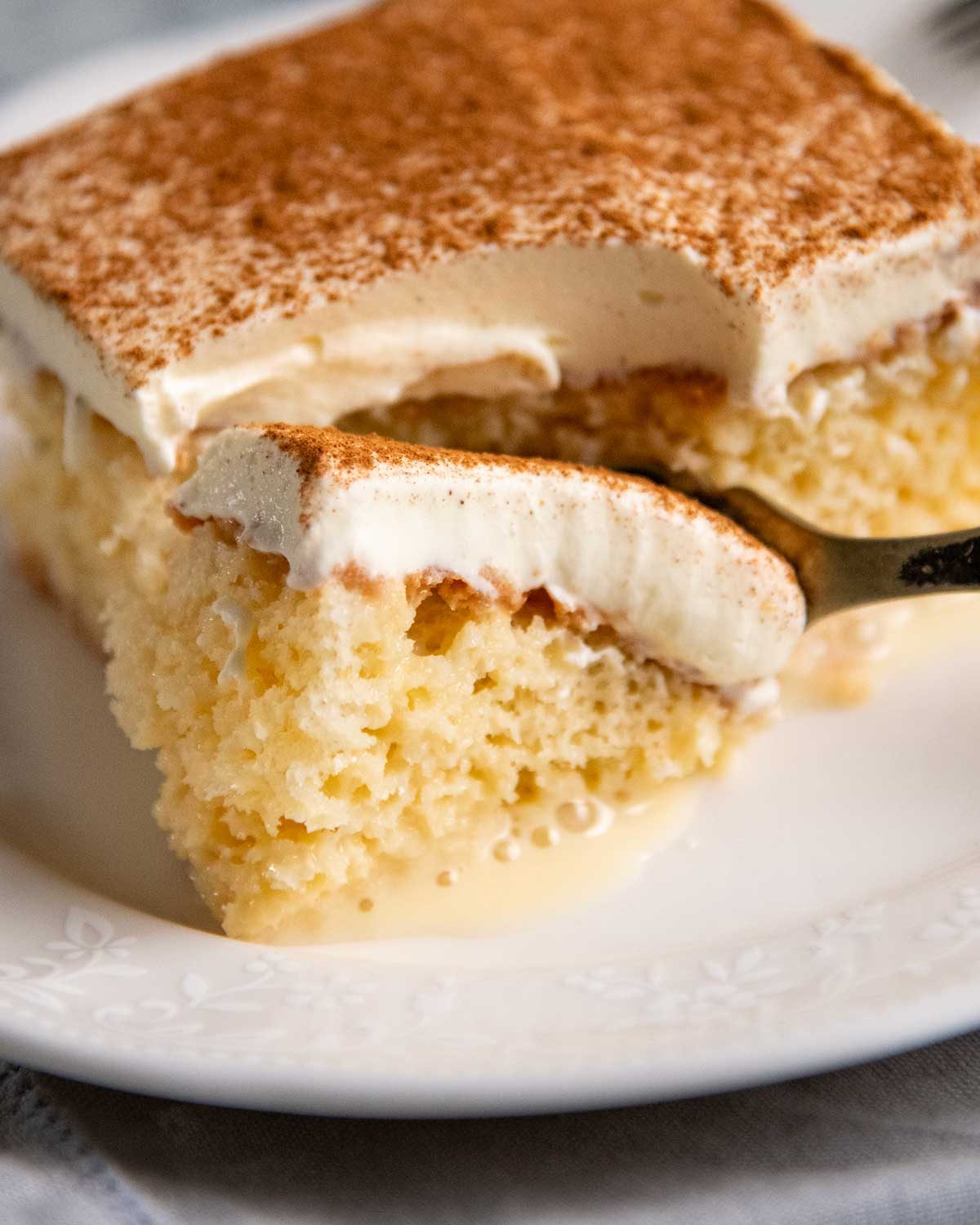
Tres Leches, the famous Latin American “3 Milk” soaked cake, has arrived!! Tastes like a soft vanilla pudding, except cold rather than warm. One bite, and you’ll understand why the world is so obsessed with it!
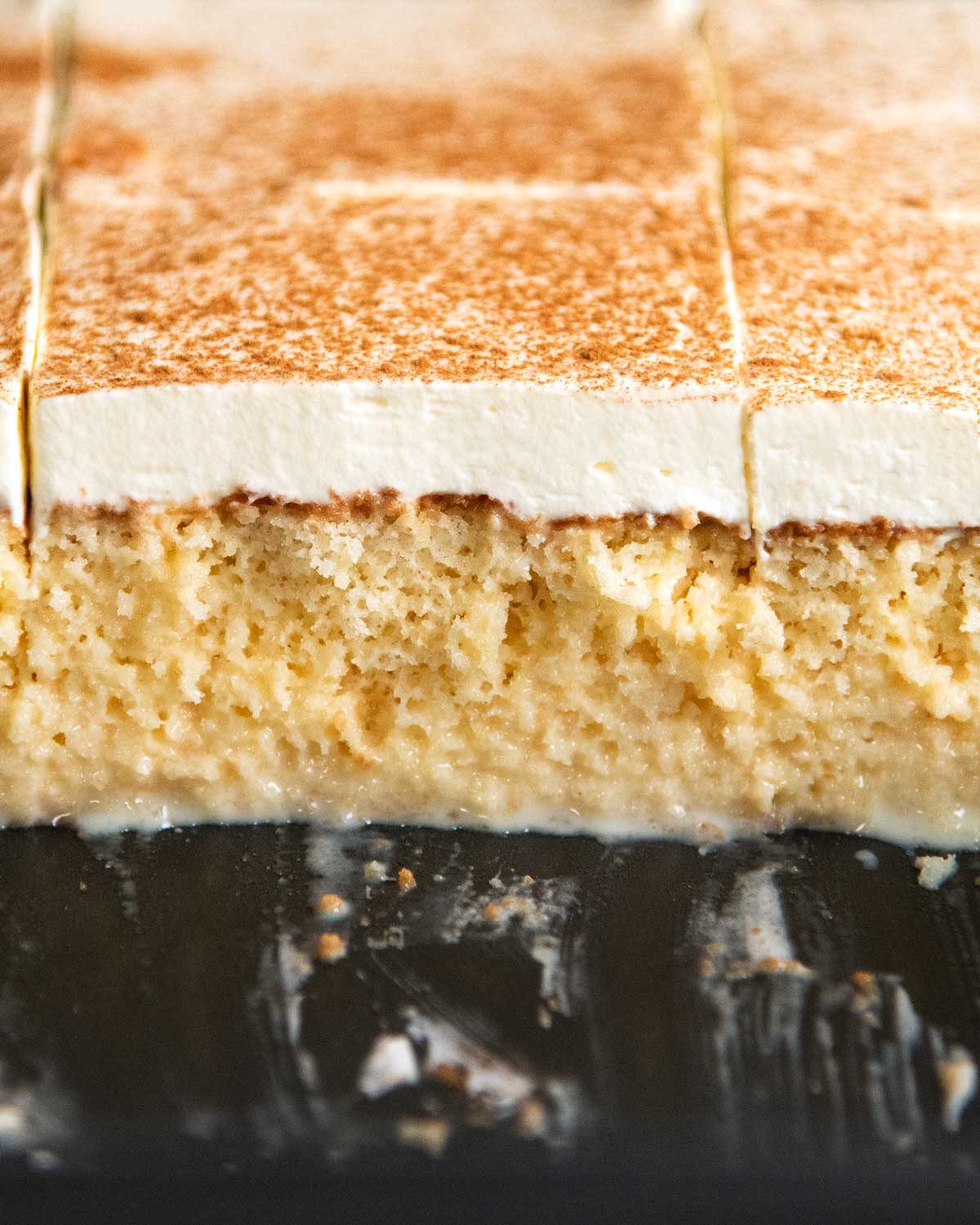
Tres Leches Cake
If you have never tried Tres Leches cake before, you’re in for a treat! It’s one of Latin America’s most iconic desserts – a cake that 700 million people are proud to call their own, that the rest of the world has fallen in love with.
Tres Leches – which literally means “three milks” – is made by soaking a vanilla sponge with a sweet mixture of three kinds of milk: sweetened condensed milk, evaporated milk and cream. The cake drinks it all up, turning into something that’s almost like a cold vanilla pudding. Despite all that liquid, it’s not soggy or mushy because the sponge is designed to absorb it while staying incredibly light and springy.
It’s a brilliant cake for sharing because of its size – 20 slices comfortably, or 12 giant slices. It stays in the pan (easy transport!), must be made ahead, and is just as good – if not better – the next day, and the next.
Oh, and it’s surprisingly on the low-end of sweet, even by Latin American standards! 😉
Adapted from an Ina Garten recipe
This Tres Leche recipe is ever so slightly adapted from Ina Garten’s recipe. Compared to other recipes I’ve tried in the past, I found her cake has an exceptionally good soft bouncy texture that holds up perfectly even when soaked with almost 4 cups of the milk mixture. It doesn’t disintegrate or get mushy and soggy, the milk mixture disperses evenly through the crumb, and the texture of the cake is plush – almost like my Vanilla Cake.
Plus it’s super simple to make. I see myself using it for other flavour-soaked cakes in the future!
See FAQ for changes I made to Ina’s recipe. Nothing significant, just a handful of minor details. 🙂
Ingredients in Tres Leches Cake
Here’s what you need to make Tres Leches Cake. I know South American desserts have a reputation for being quite sweet, but this Tres Leches actually is not. It is less sweet than typical western cakes. 🙂
1. Three Milk Soaking Mixture
Well, 2 types of milk, plus cream! Some recipes use milk instead of cream, but I much prefer cream. It adds richness to the cake which, although soft and springy, is made without any fat (other than the fat in eggs). For this reason, I also recommend using full fat for each of the milks below though if, for health reasons, I needed to, I would absolutely still make this recipe with low fat of all three.
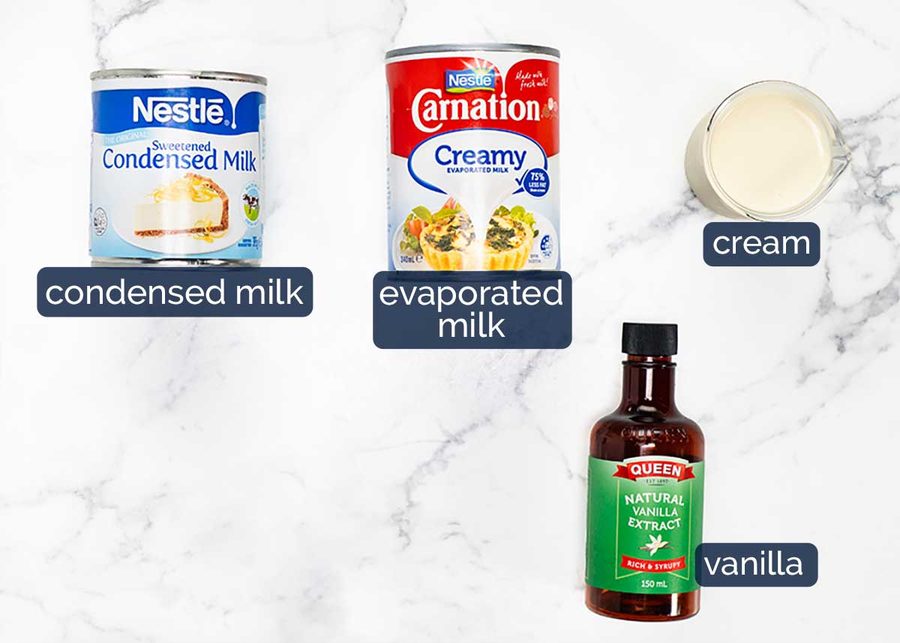
Sweetened condensed milk – This the milk in a can that has been sweetened and it has a thick syrup consistency. It brings sweetness into the cake. Find it in the long-life milk aisle.
Evaporated milk – Unsweetened concentrated milk that has a slightly thicker pourable consistency than fresh milk. Sold in cans alongside the sweetened condensed milk.
Cream – As noted above, I like to use cream rather than milk to bring a little much needed fat into the cake. But actually, you could use milk instead, if you prefer. But use less, as it is thinner so it will soak the crumb faster than cream.
Vanilla – Use natural extract rather than imitation essence which is artificial.
** Optional: almond extract ** Ina Garten’s recipe also includes a small amount of almond extract (just 1/2 teaspoon). It’s not traditional but it’s a common variation, particularly in US versions, I’ve noticed. It adds the smaller hint of amaretto flavour and it is really lovely. So while it’s not in my base recipe, if you’ve got almond extract I highly recommend giving it a go!
2. THE CAKE
Here’s what you need to make the cake.
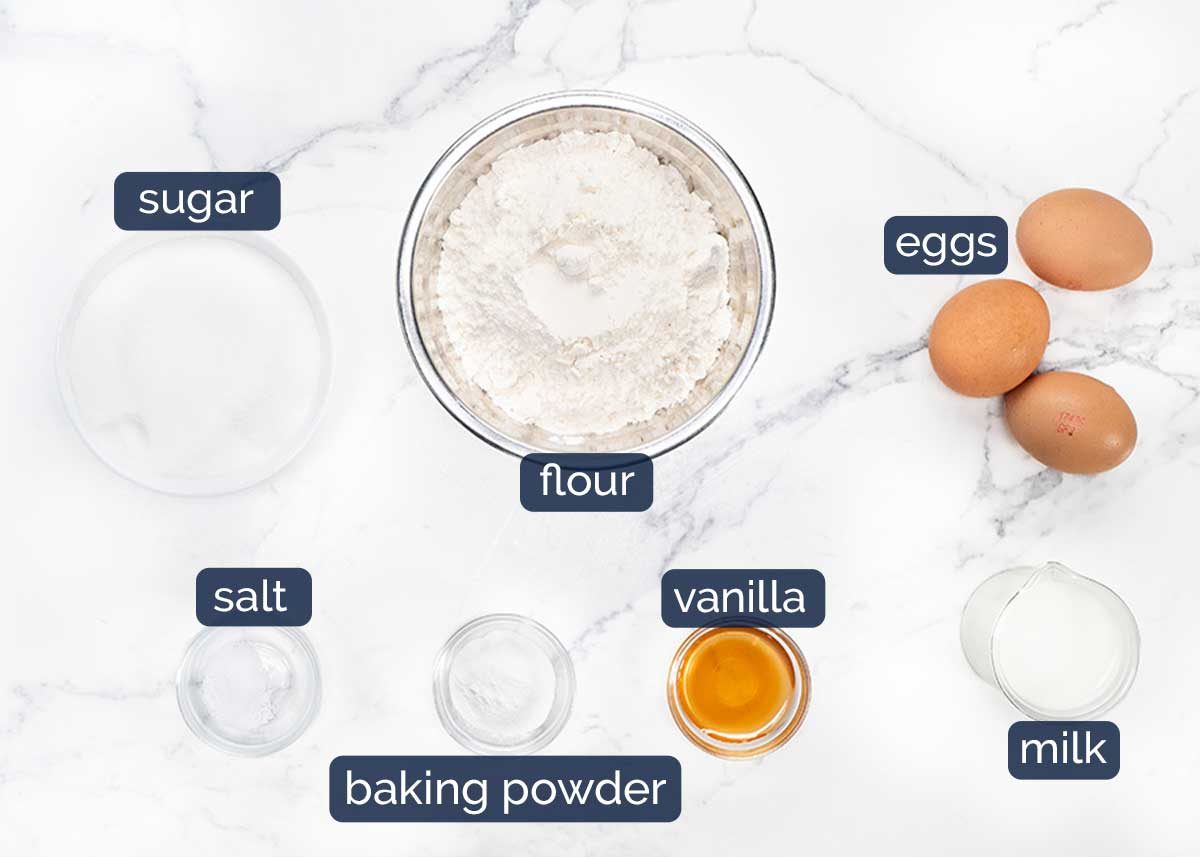
Flour – Just plain / all-purpose flour. Don’t use self raising flour, the rise of this cake is more delicate than some and if you don’t use the exact amount of baking powder, it might not be as fluffy as it should be.
White sugar – You can use either caster sugar (superfine sugar) or regular / granulated sugar. Caster sugar is my default as it is suitable for 95% of my cooking and baking, whereas granulated sugar is not (larger grains so it doesn’t dissolve as quickly).
Eggs – You will need 3 large eggs which are eggs sold in cartons labelled “large eggs”. They are ~50 – 55g/60g each. If yours are much larger or smaller, see this post for how to convert to use the correct amount.
Make sure the eggs are at room temperature as fridge-cold eggs do not fluff up as well when whipped, and this cake relies heavily on the whipped eggs to make it rise. To bring them to room temperature quickly, just pop them in a bowl of warm water for 5 minutes. (Not hot – you’ll cook the eggs!)
Baking powder – In addition to the whipped eggs, baking powder also lends a hand to make the cake rise. If yours has been sitting in the pantry for a while, check to make sure it’s not dead (here’s how). Don’t substitute with baking soda in this cake.
Vanilla – For flavour.
Salt – To bring out the flavours in the cake. Standard baking protocol these days. 🙂
How to make Tres Leches Cake
You’ll need to start this cake at least 5 1/2 hours before you plan to serve it as it needs at least 4 hours in the fridge for the cake to absorb all that milky goodness and disperse evenly, plus 30 minutes cooling time. To be honest, it’s even better the next day as I feel like the cake has settled and slices more neatly once it is well and truly chilled all the way through.
1. make the cake
Like my Vanilla Cake, this cake gets its soft, springy crumb by beating whole eggs for 10 minutes to aerate them. If you’ve got a stand mixer, it’s wonderfully efficient – while the eggs are whipping, you can measure the remaining ingredients and butter the pan.
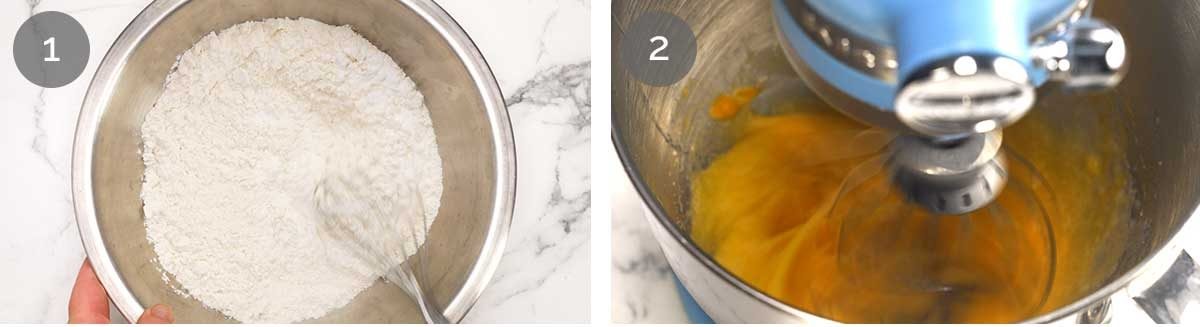
Whisk dry ingredients – Whisk the flour, baking powder and salt in a bowl, then set aside.
Beat eggs 10 minutes – Put the eggs, sugar and vanilla in a bowl of a stand mixer fitted with the whisk attachment. Then beat on medium high (speed 8) for 10 minutes. It will be pale yellow and fluffy, and the aeration in the eggs is what makes the cake rise.
If using a handheld electric beater, use high speed and just alternate arms if they start getting tired!
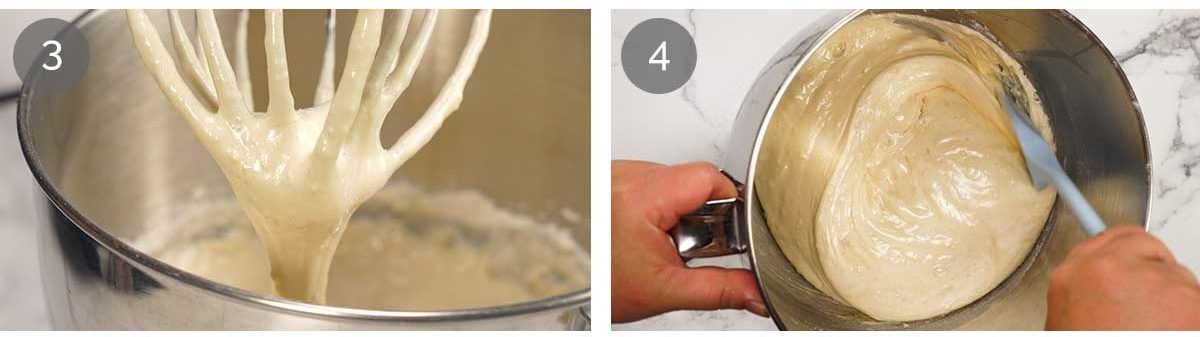
Flour and milk – Turn the speed down to low. Then with the beater still going, slowly pour in half the flour, all the milk, then remaining flour. Stop the beater once most of the flour is incorporated.
Finish by hand – Use a rubber spatular to ensure the batter is properly combined (check the base), but don’t keep mixing unnecessarily as you will deflate the batter and end up with a cake less fluffy than it could be!
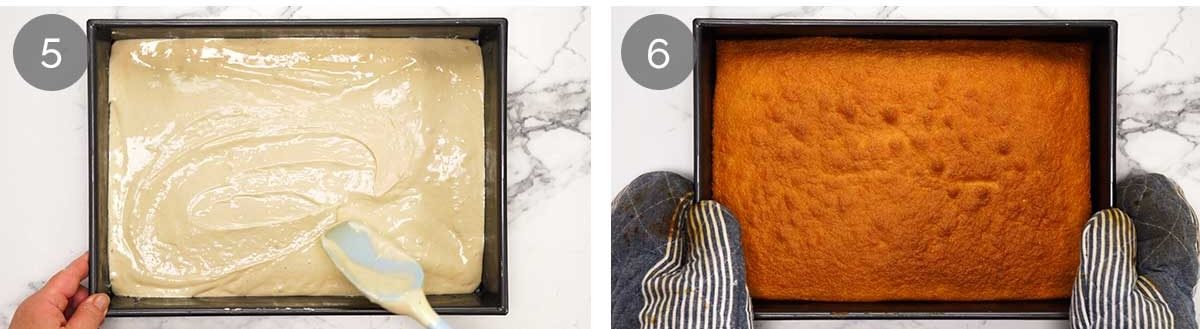
Pour into a 23 x 33cm / 9 x 13″ butter greased pan. Bake for 25 minutes at 180°C/350°F (160°C fan-forced), or until a skewer inserted into the centre comes out clean. The top will be a deep golden.
Cool for 30 minutes in the pan before proceeding with the poke and soak. This ensures your cake won’t disintegrate into a soggy mess when you pour the milk mixture over. Cakes are fragile when hot.
2. poke, soak and refrigerate
Poke with enthusiasm! More poking = more even soaking!
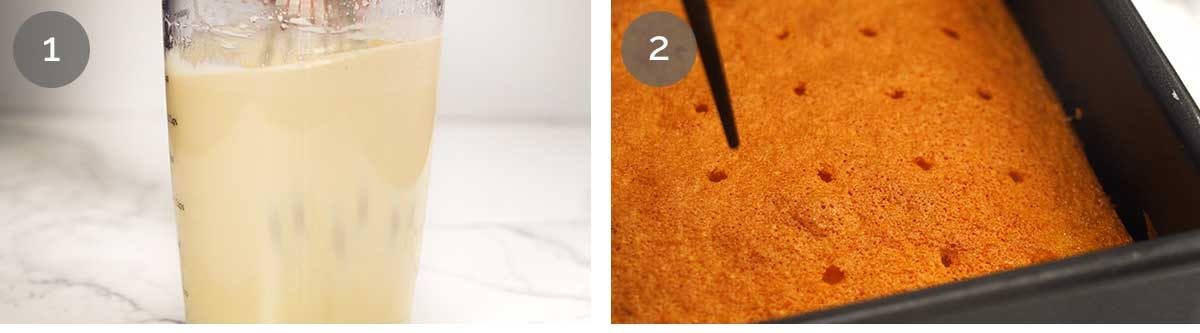
3-Milk mixture – In either a very large jug (~1.5 litres / quarts) or a large bowl, whisk the 3-Milk ingredients together.
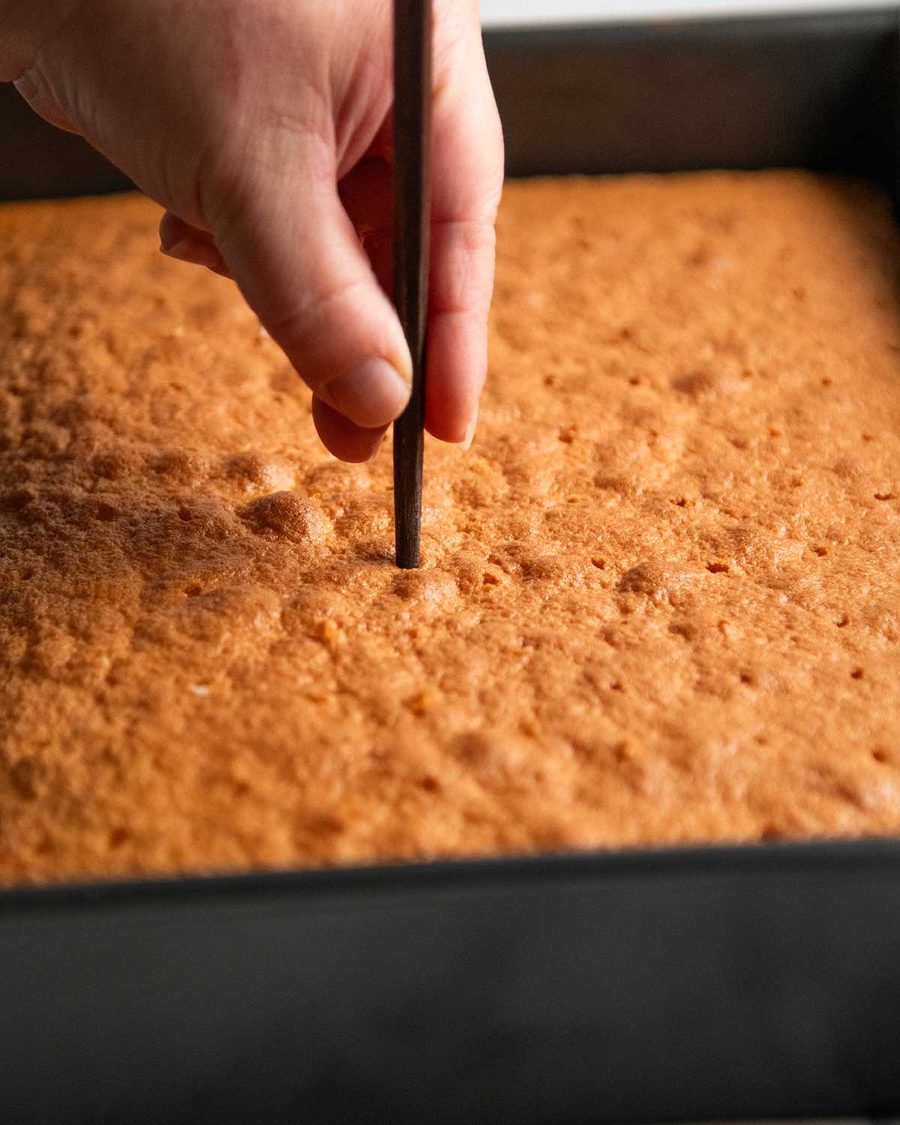
Poke lots and lots of holes in the cake, all the way down to the base using a thin chopstick*. I do around 130 – ten rows of thirteen holes. Lots of holes encourages more even distribution of the milk mixture. Nobody wants to hit a dry patch with Tres Leches cake!
* Note on poking device – I know most recipes say to use a bamboo skewer or fork, but I kept ending up with some dry patches because the holes are too small, even with lots of poking. A thin chopstick lets the milk soak through faster and more evenly. Don’t worry about the larger holes, the crumb expands as it absorbs the milk, so the tunnels disappear.
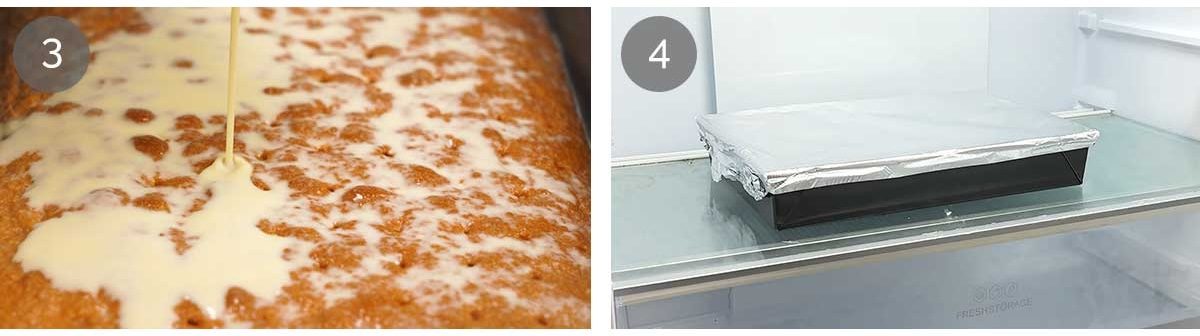
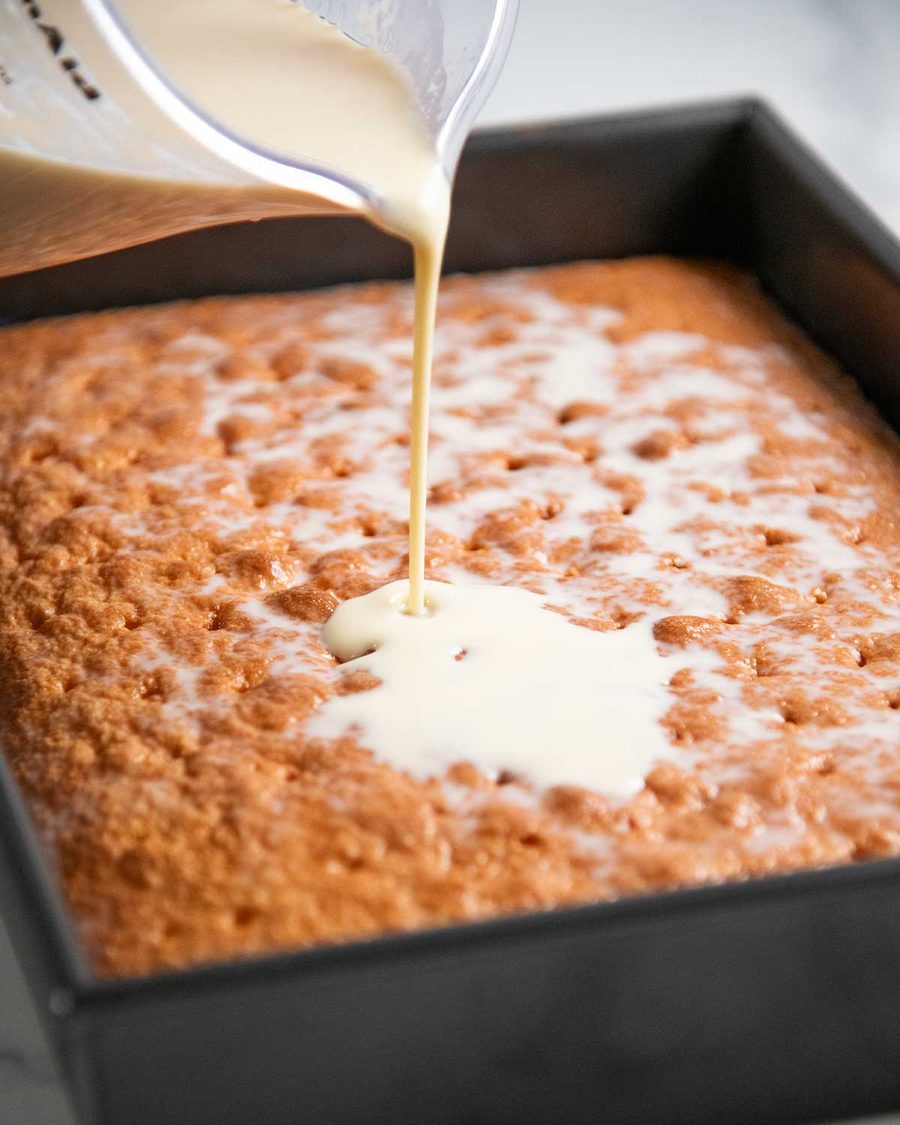
Soak – Slowly pour the milk mixture over in about 3 additions, giving it a minute or between pours if needed to allow it to soak in before pouring more on. Because we poked with chopsticks, you’ll find the milk mixture absorbs much faster and more evenly than tiny holes made using skewers.
Refrigerate for at least 4 hours, or even overnight, to allow the milk mixture to soak evenly into the cake.
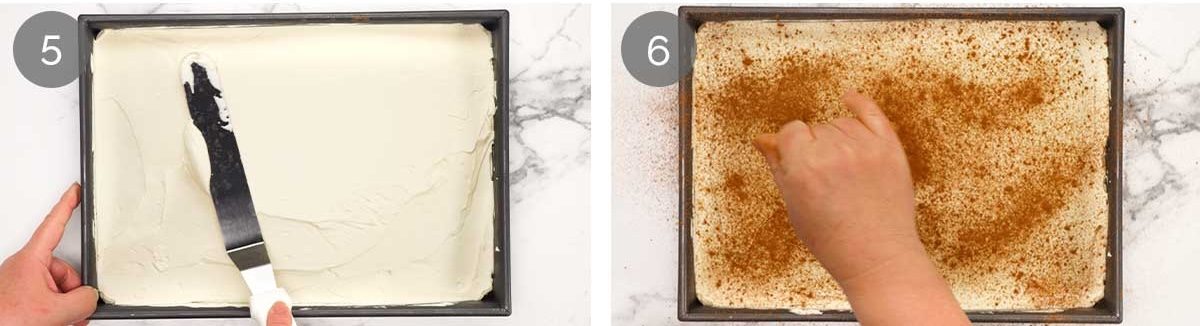
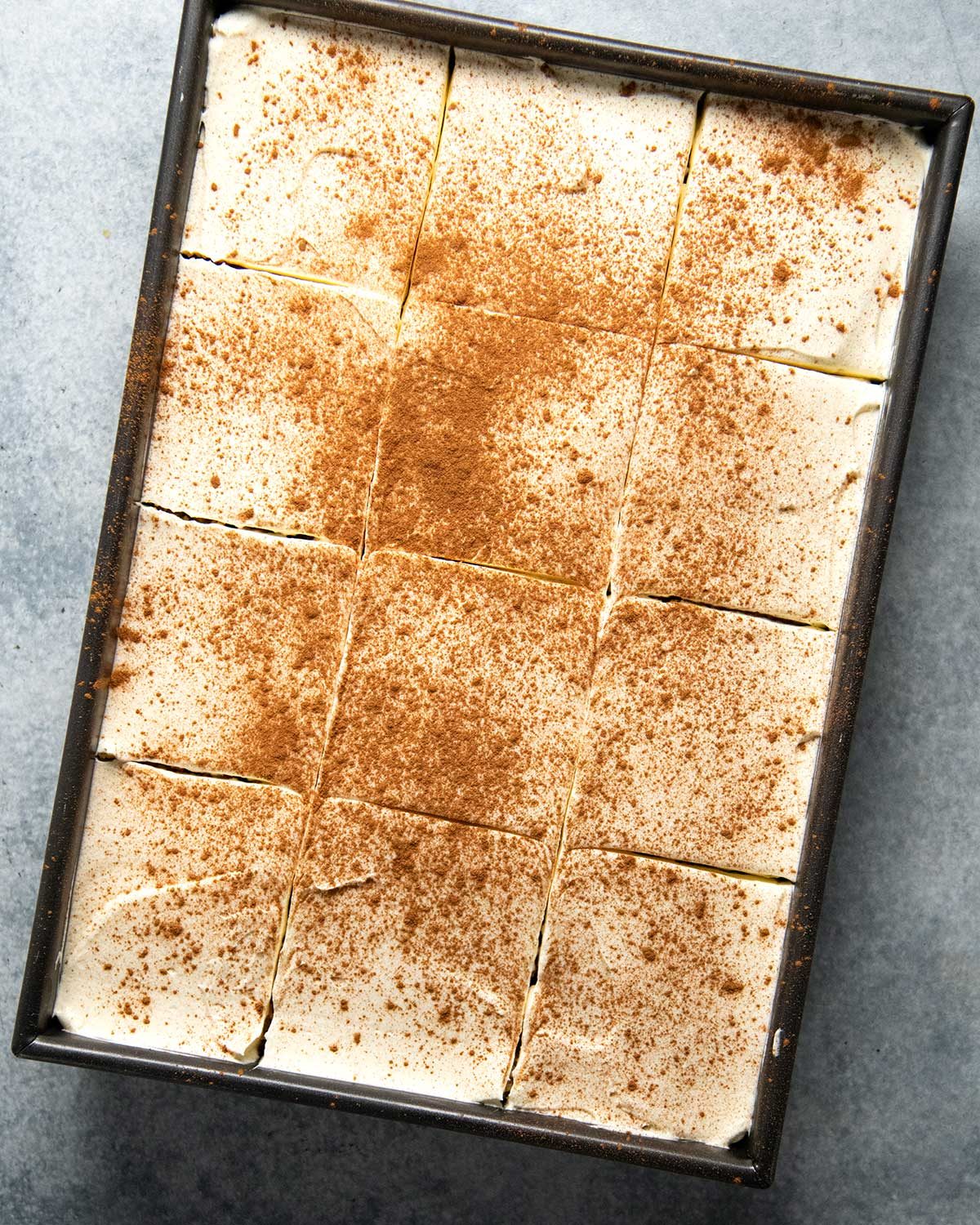
Whip the cream then spread it all over the cake.
Sprinkle with cinnamon then cut! Keep it in the pan so it holds all the milky goodness in.
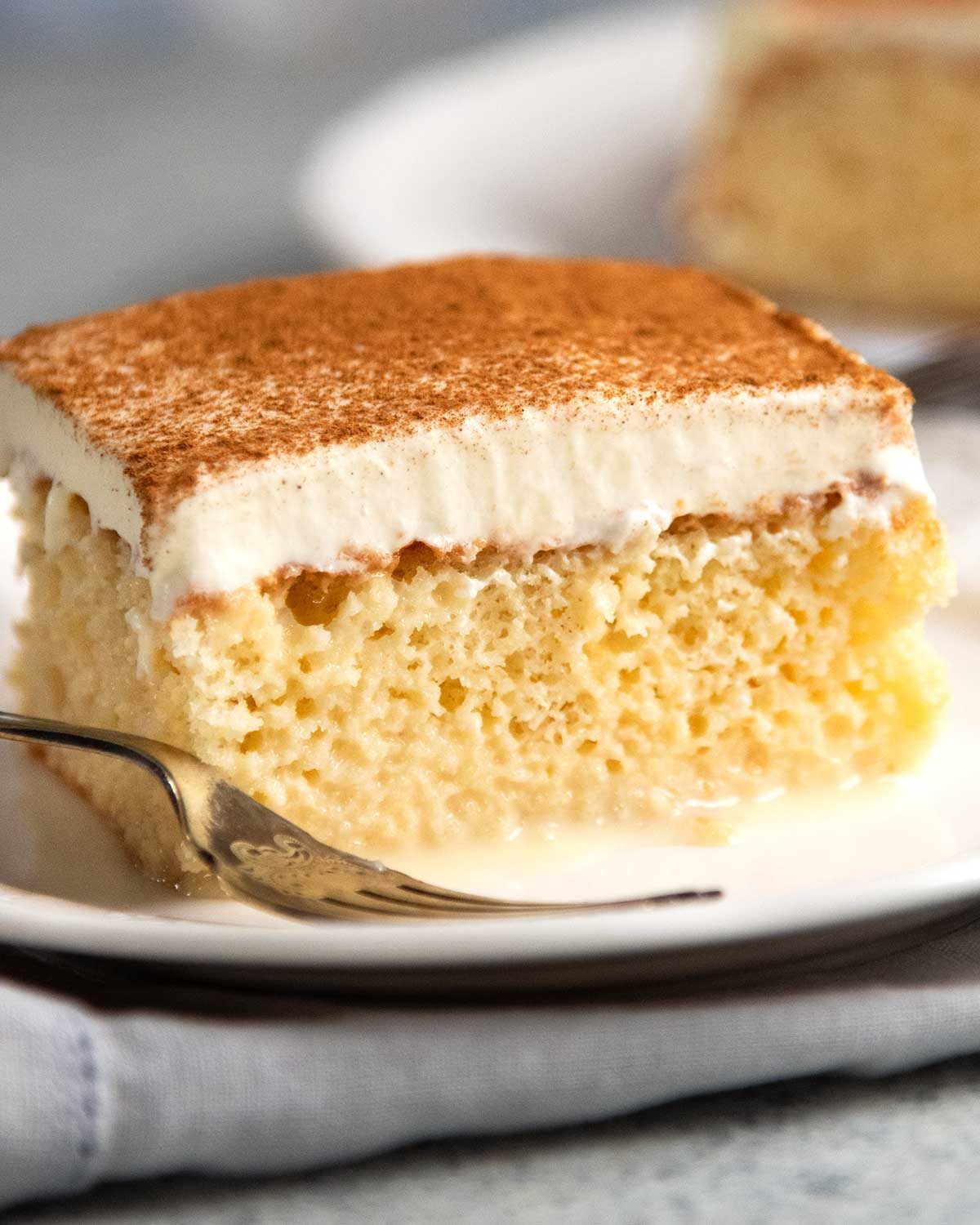
Storing and making ahead
Tres Leches Cake is one of those rare cakes that is actually better made ahead which makes it a terrific one for gatherings – especially in summer. It keeps beautifully for 2 days, and is still terrific for up to 4 days in the fridge, and I also appreciate that it’s a cake that is great eaten cold, straight out of the fridge. Because, how frustrating is it when the urge for cake hits you but that buttercream frosting has gone rock hard in the fridge and you have to wait half an hour before digging in?? 😖
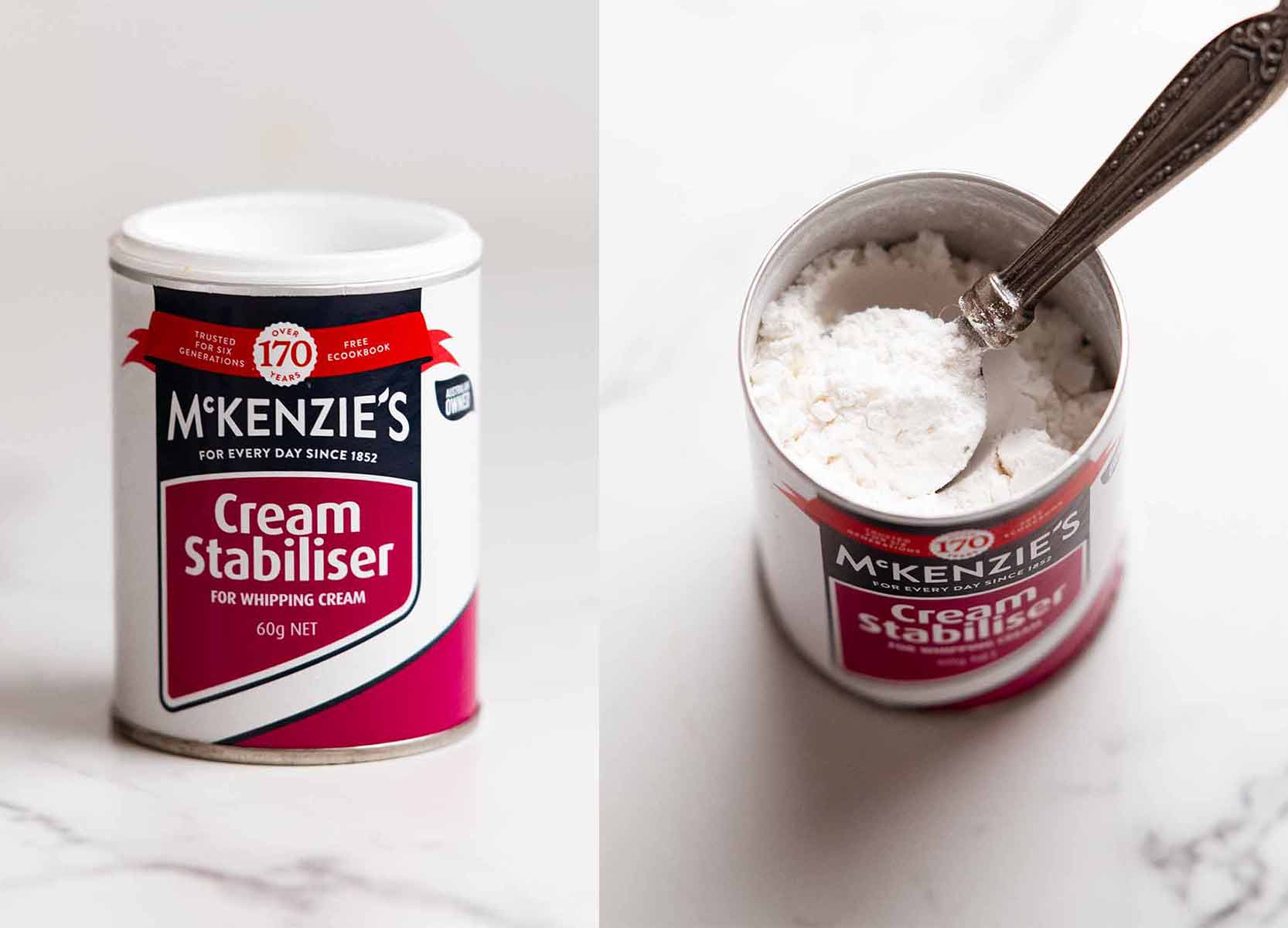
The whipped cream will hold up well for 2 days because it’s not pipped or sandwiched, though it will stay in freshly-whipped-fluffy-perfection if you stabilise the whipped cream. McKenzie’s Cream Stabiliser powder is now a staple in my pantry – just add into the cream, whip as usual, and it stays fluffy for 3 days. For other ways to stabilise whipped cream, see the recipe here.
Righto, I’m off! I have leftover cake to enjoy. Happy poking and soaking – and even happier eating! – Nagi x
Tres Leches Cake FAQ
Unfortunately I haven’t tried, sorry!
Up to 4 days, though it is best for the first 2 days after making it (ie make it today, then it’s great tomorrow and the day after).
On day 3, the milk mixture starts to soak the crumb a bit more and makes the cake seem “wetter” – you’ll notice it seeping out of the base a little more. But it is still fabulous and I’d happily scoff down a slice and serve to family and friends.
Also, be mindful of the shelf life of the cream you used.
The whipped cream does start to deflate but it is ok for 2 days because it’s just spread on top rather than piped or sandwiched. If you want leftovers to remain with fluffy whipped cream perfection (or you want to top with cream now and serve later), I highly recommend stabilising the whipped cream. These days, I always have a jar of McKenzie’s Cream Stabiliser on hand for this very reason (see below) – just add and whip it with the cream, and it will stay fluffed like freshly whipped for days. You can find it in the baking aisle of Coles and Woolworths (in Australia).
For other methods to stabilise whipped cream, see my Stabilised Whipped Cream recipe!

This Tres Leches recipe is slightly adapted from Ina Garten’s recipe. I’ve tried a number of Tres Leches cakes over the years, but I haven’t shared a recipe until now because I wasn’t overly thrilled – common problems being that the sponge became a little mushy for my taste after soaking, or there were dry patches, or the cake texture was a little too “rough” rather than plush.
Then I recently tried Ina’s recipe. The sponge stays incredibly soft and springy, even after soaking up almost 4 cups of the three-milk mixture. Every bite has that gorgeous milky flavour in the cake which has a texture like regular cake rather than turning into soggy mush.
I think the secret is the cake itself. Unlike many recipes that separate and whip the eggs or include butter or oil, Ina simply beats whole eggs with the sugar and doesn’t add any fat to the batter. The result is an intentionally lean sponge that’s dry before soaking and has a “spring-back” crumb, and is perfectly designed to drink up all that milk while keeping its structure.
It’s also wonderfully easy to make – no whipping separated eggs – which, to be honest, is what prompted me to give it a go in the first place!
Thank you Ina! You’re my favourite, and always will be!
I did fiddle with Ina’s recipe, but there’s a reason for it!! Here are the changes I made:
Reduced the amount of the three milk soaking liquid by half a cup as I felt there was a little more than necessary. The cake along the sides of the pan where the milk mixture pools got a little more soaked than ideal.
I use a chopstick rather than thin skewer for poking because I find it works better (and faster) for even absorption.
Almond extract – Ina Garten uses almond extract in the milk mixture which I made optional as it’s not traditional, though really lovely!
I refrigerate for 4 rather than 6 hours. Using the chopstick which is fatter than a skewer allows for the milk mixture to disperse through the cake faster.
I top with cinnamon powder (traditional) whereas Ina Garten uses berries.
At Dulcito Desserts, located in Broadway and Zetland. The Tres Leches is highly rated by the local Latin American community! This is the bar to which I was working to. And, hand on heart, I genuinely think this Tres Leches recipe matches theirs. Thank you Ina!
Watch how to make it
Hungry for more? Subscribe to my newsletter and follow along on Facebook, Pinterest and Instagram for all of the latest updates.
Tres Leches Cake
Ingredients
Cake:
- 1 1/2 cups plain flour / all-purpose flour
- 2 tsp baking powder (make sure yours is not dead)
- 3/4 tsp cooking salt / kosher salt
- 3 large eggs , at room temperature (~50 – 55g/2oz each)
- 1 cup white sugar (any type – caster sugar/superfine, or regular/granulated)
- 2 tsp vanilla extract
- 1/2 cup full-fat milk , at room temperature
3-Milk Soaking Mixture:
- 1 x 340g/12oz can evaporated milk (Note 1)
- 1 x 395g/14oz can sweetened condensed milk (Note 1)
- 1 cup thickened cream / heavy cream , or regular full-fat cream (Note 2)
- 1 tsp vanilla extract
- 1/2 tsp almond extract , optional (Note 3)
Cream topping:
- 1 1/2 cups thickened cream / heavy cream , or other whipping cream
- 3 tbsp white sugar
- 1 tsp vanilla extract
- 1/2 tsp+ cinnamon powder , for sprinkling (Note 2)
Instructions
Cake:
- Preheat the oven to 180°C/350°F (160°C fan-forced). Grease a 23 x 33cm / 9 x 13" pan with butter (do not line with paper).
- Dry ingredients – Whisk the flour, baking powder and salt in a bowl. Set aside.
- Beat eggs 10 minutes – Put the eggs, sugar and vanilla in the bowl of a standmixer fitted with the whisk attachment. Beat on medium high for 10 minutes – it will become pale yellow and fluffy. (Or use an electric beater on high for 10 minutes – just alternate arms if they get tired!)
- Add flour mixture and milk – Reduce the speed to low. With the mixer going, slowly add half the flour mixture, then all the milk, then remaining flour mixture. Stop beating as soon as most of the flour is incorporated. Then use a rubber spatula to mix the batter, scraping the base well, just to ensure everything is properly combined. Don't mix unecessarily long, you will deflate the batter!
- Bake – Pour the batter into the prepared pan. Bake for 25 minutes or until a skewer inserted into the centre comes out clean. Cool 30 minutes before poking and soaking.
Poke and soak!
- Whisk the 3-Milk ingredients in a large bowl or very large jug (1.5L/quarts) until the condensed milk is mixed through.
- Poke – Use a thin chopstick, poke lots of holes all the way down to the base of the pan. I do around 130 – 13 rows of 10!
- Soak – Slowly pour the milk mixture all across the top in about 3 additions, giving it a minute or two between pours so it has time to soak in rather than pooling. Pour with even soaking coverage in mind – eg if it is pooling on the sides because the cake is sloped, concentrate more on the centre and pour slowly.
- Refrigerate at least 4 hours, or even overnight, to allow the milk mixture to disperse throughout the cake.
Assemble to serve – day of:
- Whip cream – Beat the cream, sugar and vanilla using the stand mixer (whisk attachment) or electric beater until it is firmly whipped.
- Cream and cinnamon – Spread the cream all over the top of the cake. (If you stabilise the whipped cream, you can top with cream the day before. I use McKenzie's Cream Stabiliser for this). Sprinkle with cinnamon – do this from a height using a fine sieve, for the most even coverage.
- Cut into 12 very generous or 20 sensible pieces. Serve out of the pan.
Recipe Notes:
Nutrition Information:
Life of Jaffle
My first dog park…..

….and my first Tres Leches cake!!

It is hard to know which one he enjoyed more!
Thanks Nagi. Interesting cake, one I’m keen to make now. I particularly appreciate you providing so much insight and explanation re stabilizing whipped cream. That was fascinating and got me doing further research so I learned something new as well – always a good thing. 👍
It’s so useful Diane! I pretty much always stabilise my cream for cakes etc, that way I always know that the leftovers will hold up 🙂 Important when you make as many cakes as I do! Pretty sure we made this Tres Leches almost 10 times leading up to today – that was a LOT of cake to give away!!!
Decadent! Can I make and serve this without the cream topping (so I don’t have to confess to my cardiologist…);)
Yes you can! I would give it a light dusting of icing sugar and cinnamon 🙂 – N xx
PS Are you allowed a scoop of ice cream? 😉
I only come here to see Jaffles pics
😂 I fully endorse this