
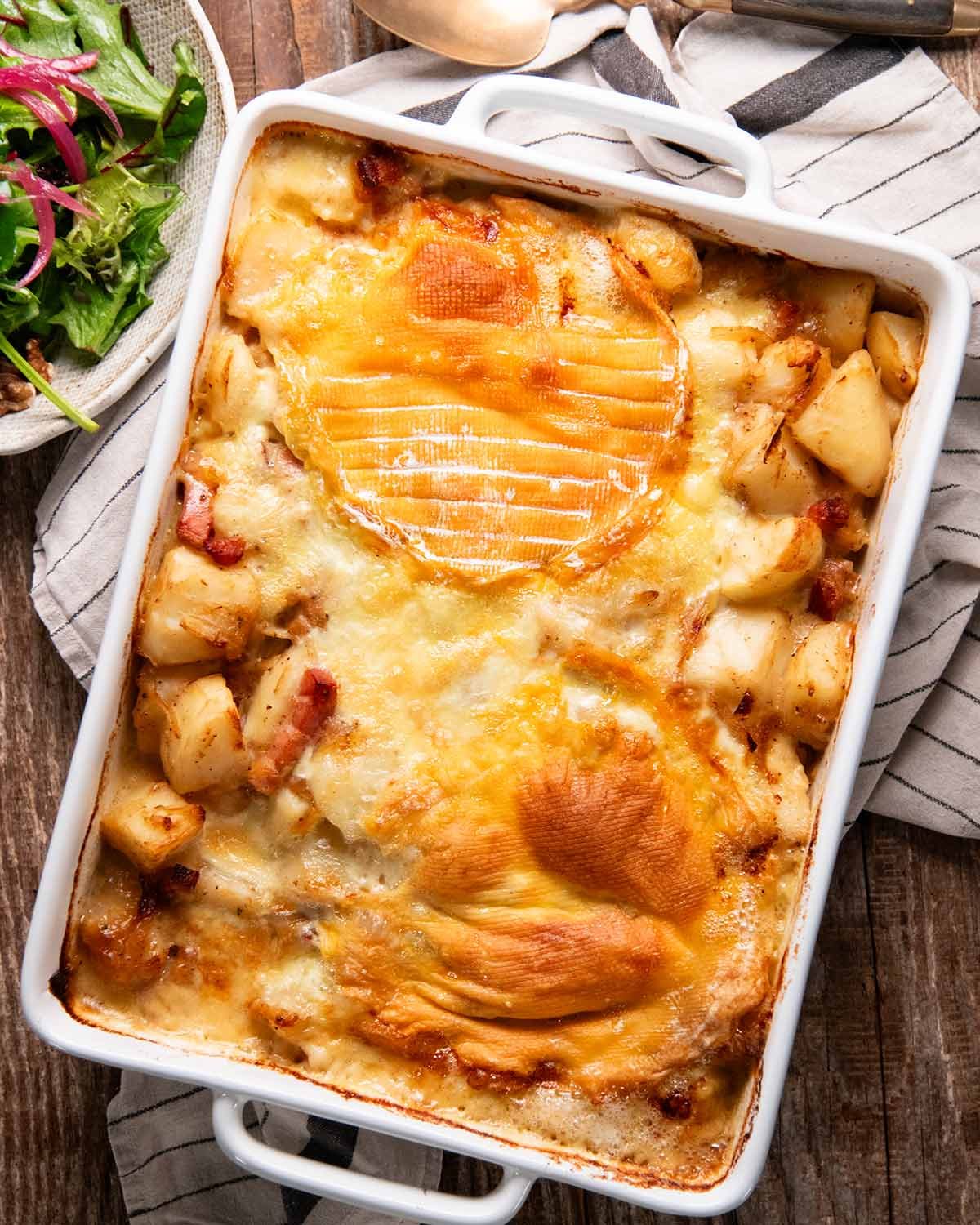
Tartiflette is the famous French potato bake from the Alps, made with just potatoes, bacon, onion and cheese that melts down to become the sauce. Potato Dauphinoise may be the better-known classic, but ask around France and some would choose Tartiflette in a heartbeat.
Nagi's Notes


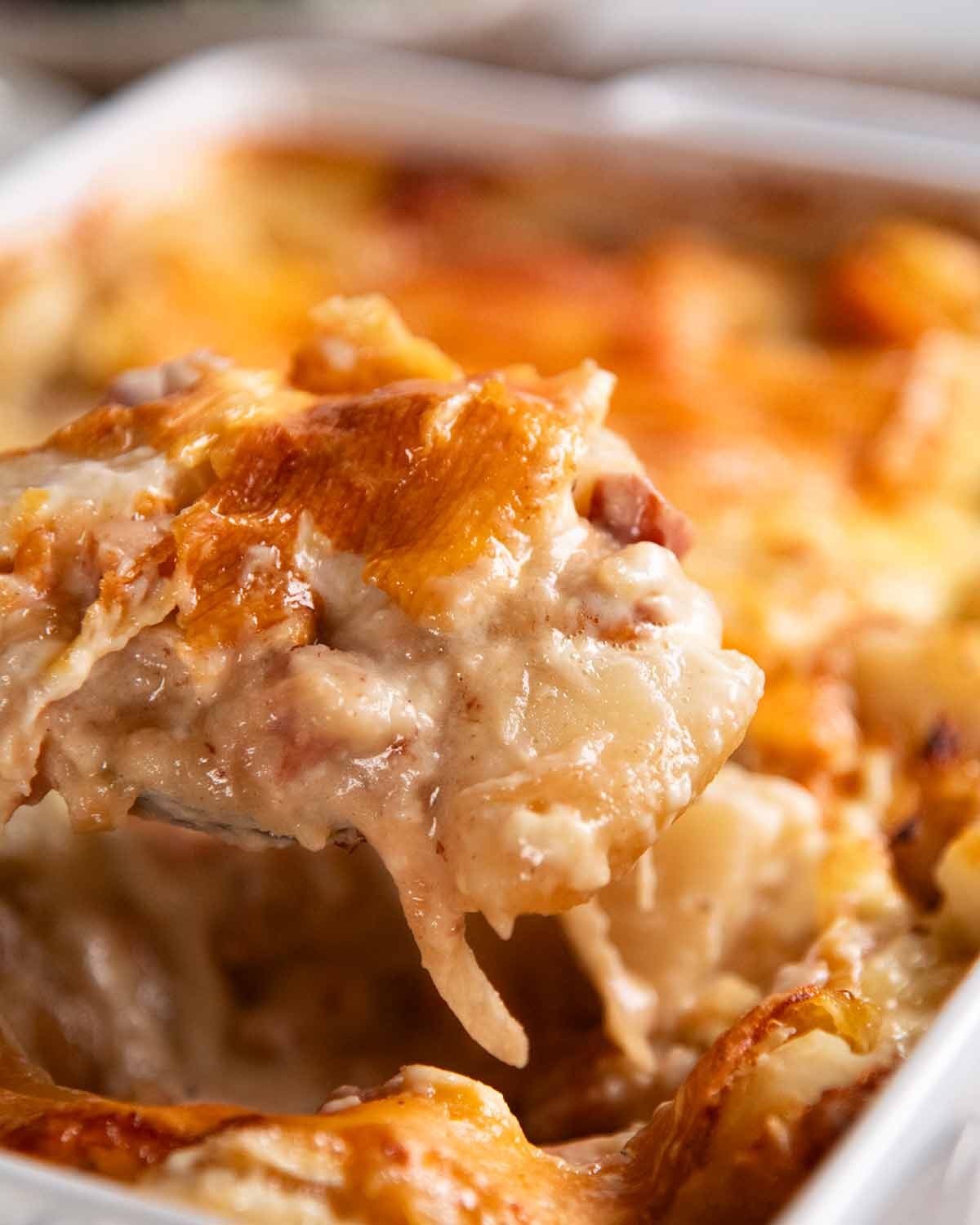
When JB told me he would love to share a recipe for this special potato bake from the French Alps, at first I was hesitant. I mean, how much better can it be than the classic Potato Dauphinoise? Then he made it. Potatoes smothered in cheese that melts down to become the sauce – I take it all back. This is one special potato dish!!
PS Reblochon is the traditional cheese, but happily you don’t need to hunt it down. Any good washed rind cheese works beautifully – JB tested plenty to make sure. But if you can only get camembert or brie, use this Brie Dauphinoise instead!


Tartiflette
Tartiflette is the famous Alpine potato bake made simply with potatoes, onion, bacon and cheese. It comes from the Savoie region, up in the French Alps, home to some of the best cheese in the country. I grew up in Lyon which is not far from Savoie and I can tell you, there is nothing like coming in from a day of skiing on the slopes to a warm Tartiflette.
Though Potato Dauphinoise may be the more famous French potato bake, Tartiflette has something special going for it – instead of cream, the melted cheese becomes the sauce. The traditional cheese used is called Reblochon which is a washed rind cheese that is notoriously difficult (and expensive) to find outside of France.
It’s a dish from home that I’ve missed and craved, and this winter I was determined to find a way to make it properly here in Australia using an alternative cheese. I was happy to find that I could make a Tartiflette every bit as good as I remember from home using cheeses I could get locally. And luckily, Nagi is famously a cheese monster, so getting through the many, many test batches was never going to be a problem!
Ingredients
Here’s what you need to make Tartiflette.
1. the cheese – reblochon
As mentioned above, the traditional cheese used in Tartiflette is Reblochon which is difficult to find outside of France. But don’t be disheartened, I’ve made it with multiple washed rind cheeses here in Australia and find it really close to the real deal. And believe me, I’m pretty particular about making sure traditional French dishes taste as they should!
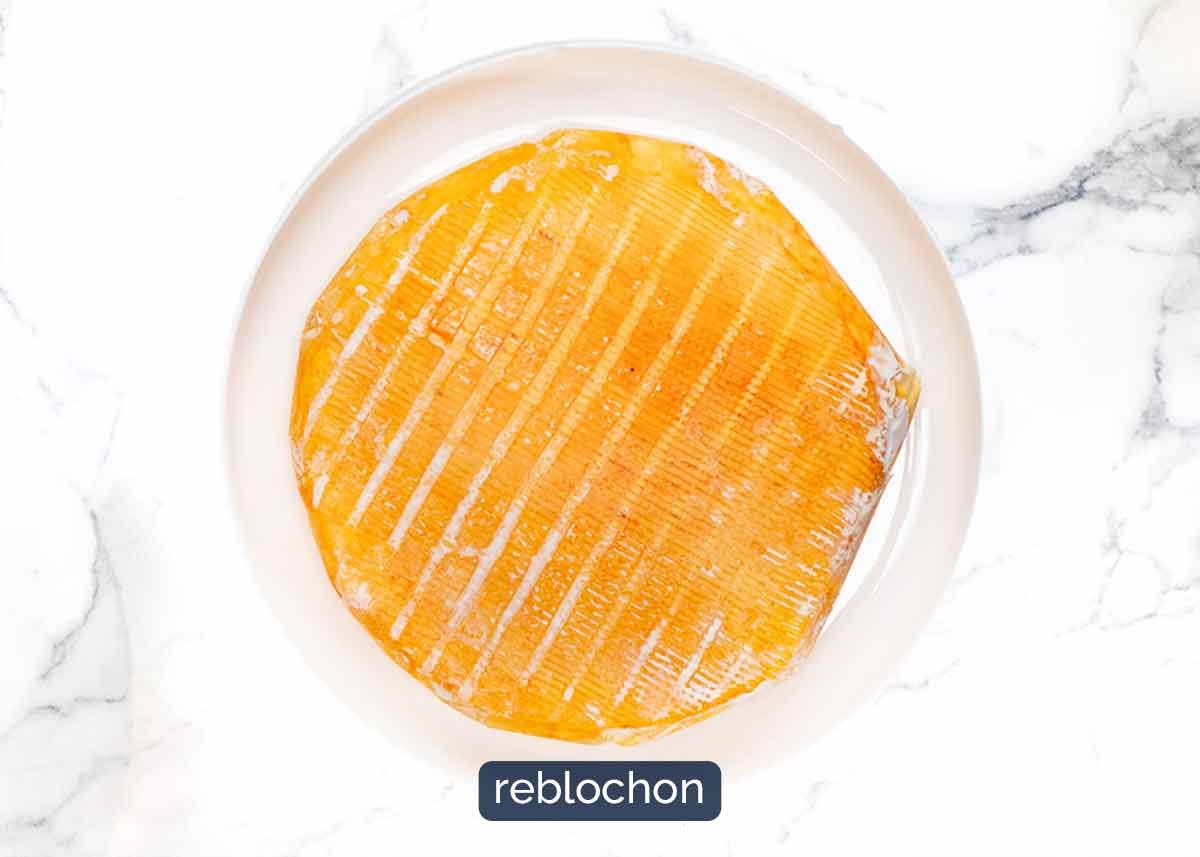
About Reblochon
Reblochon is a washed rind cheese which is a type of cheese that is soft and creamy like brie and has the signature slightly funky flavour that comes from the way the rind is washed as the cheese ages. It is made in the Savoie and Haute-Savoie regions near the Alps, traditionally with raw milk from cows native to the region. The rind is white when young and becomes orange as the cheese ages, and a rich, gently pungent flavour that mellows once baked.
The cheese melts beautifully and runs throughout the dish to coat all the potato, which is why you don’t need cream or any other sauce in this dish.
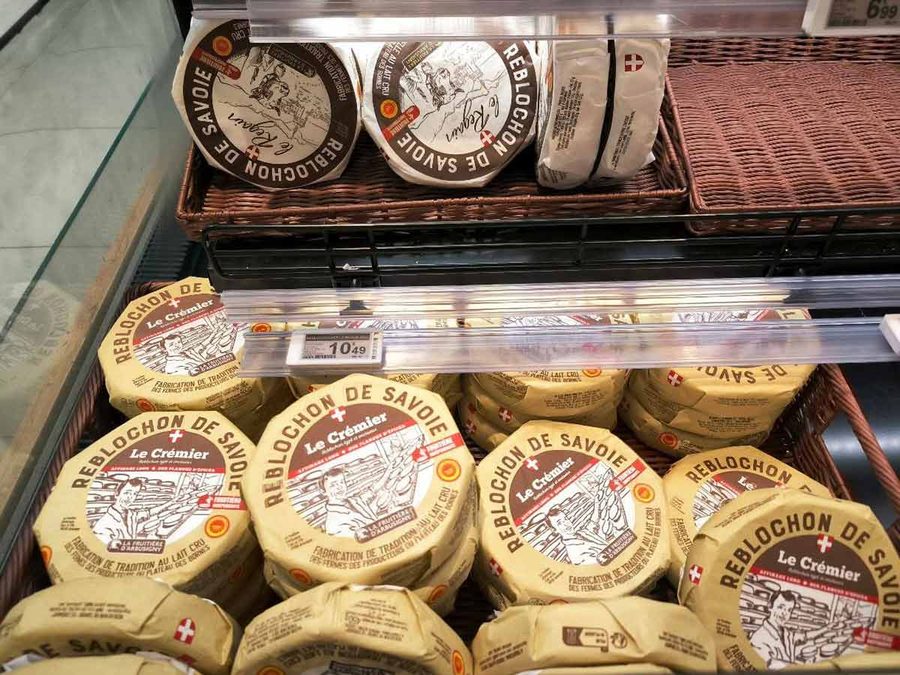
Where to get Reblochon
In France, Reblochon is found at every grocery store. But sadly outside France, genuine Reblochon can be tricky to track down, largely because they fall foul of import laws in countries like Australia and the US.
But as I said above, I have tried Tartiflette with many other washed rind cheeses. Here are other cheese that can be used:
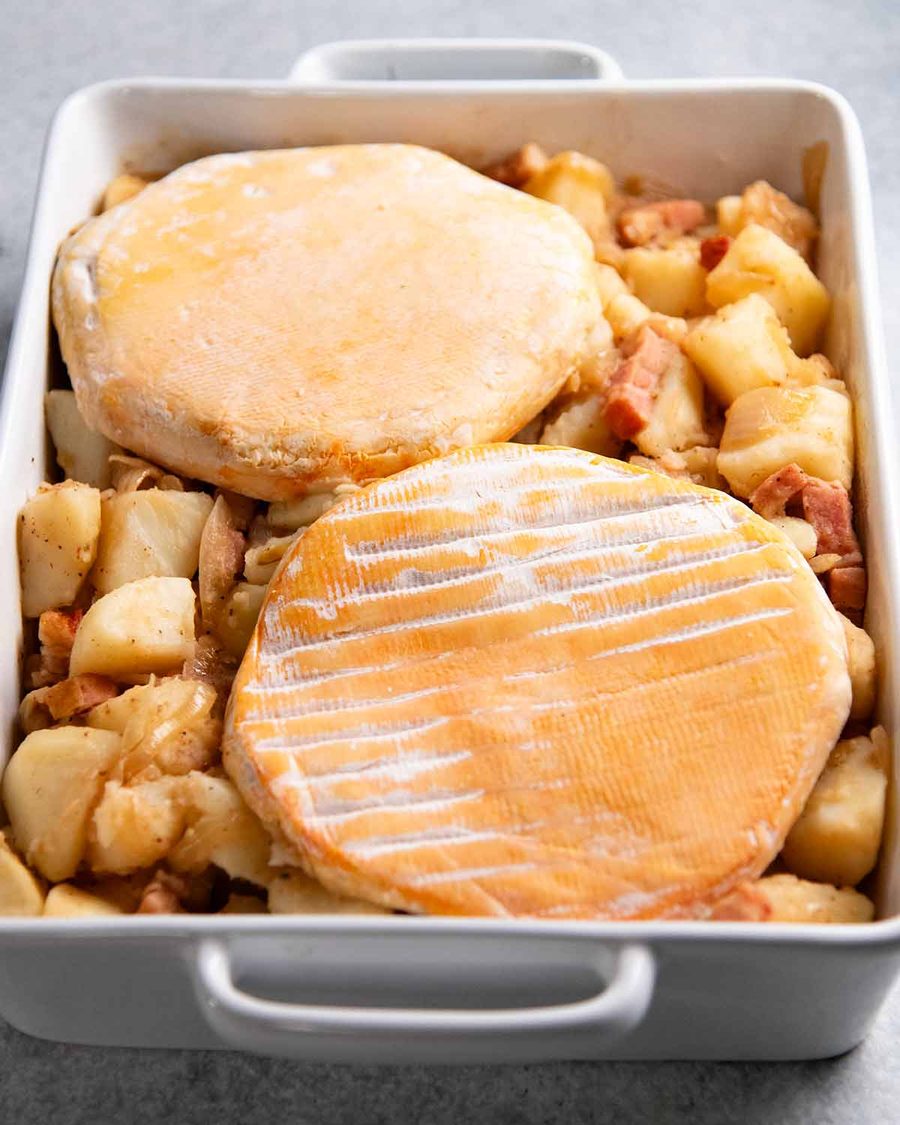
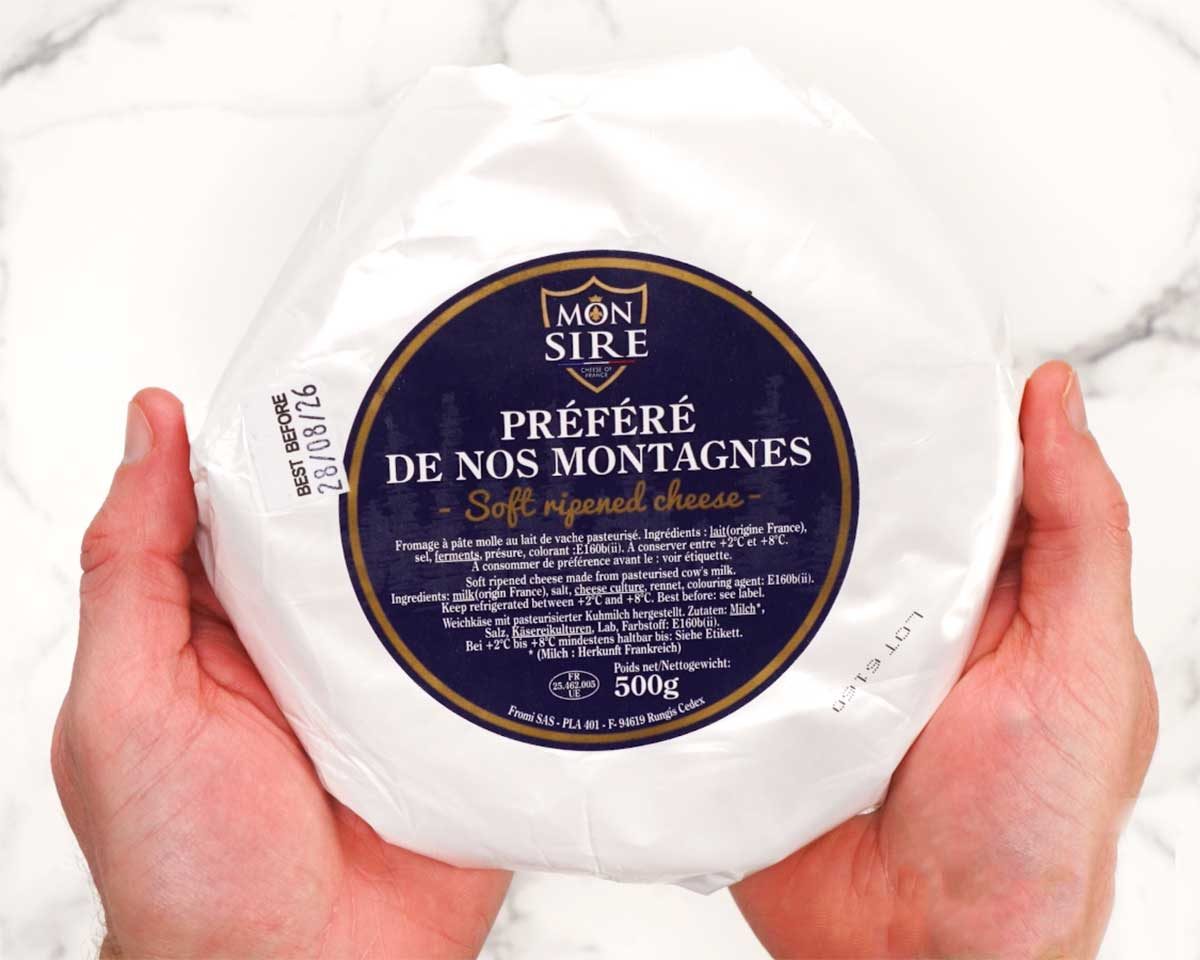
Préféré de Nos Montagnes (what I used, photo below) – This is a Reblochon-style cheese from France. The reason this can be imported is because it is made with pasteurised milk whereas genuine Reblochon uses raw milk. I find the flavour of this to be extremely close to genuine Reblochon, there is barely any difference. I got this from Le Petit Marche, a French deli in Newport, Sydney and it’s carried at speciality cheese shops as well as online and at French markets.
Délice du Jura – This is another French Reblochon-style cheese that is from another region which can also be found online, markets and speciality stores.
Saint-Nectaire – This is a washed rind cheese that is not a Reblochon-style cheese but it has similar flavour and melting characteristics so it is a great alternative. Find it online, at speciality French cheese stores and online.
Other washed rind cheeses – The 3 cheeses I talk about above are the closest washed rinds to Reblochon. But there are many other varieties of washed rinds at different price points and sizes, of which I have tried quite a few over the years and found them all to be enjoyable.
Taleggio – This is the most accessible and affordable option. It is a washed rind cheese that has similar flavour and melting properties to genuine Reblochon. In my area it is carried at Harris Farms (I’m in Sydney) and I’ve seen it in larger grocery stores like Woolworths and Coles that have speciality cheese sections. Taleggio varieties range in price, but don’t hesitate to pick up the best value one as I have made this with the cheapest Taleggio I could find and it was still delicious.
If you get cheese that are wedges rather than a whole wheel like pictured above, then still cut them in half horizontally or cut into chunks and scatter across the surface of the dish. See FAQ for photos.
2. Everything else for the tartiflette
You’ll see some recipes use cream but traditional versions do not because the sauce of Tartiflette is supposed to be just the cheese.
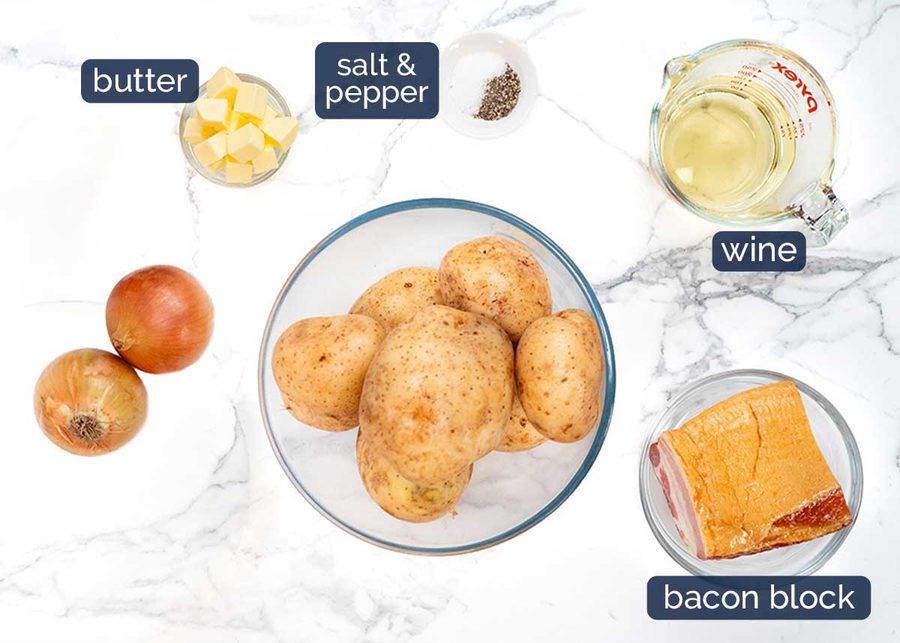
Potatoes – All potato types will work fine here, really, I’ve tried it with the waxy kind (red potatoes) and it turns out well. But my favourite is the starchy kind. They still hold their shape after boiling and become tender to absorb all the flavours while baking. (Sebago in Australia – the dirt covered ones you see on the shelves, Russet in the US, King Edward or Maris Piper in the UK are perfect).
Bacon – Brings pops of salty meatiness and lovely smoky depth against the creamy richness of the reblochon cheese. Get slab bacon from your butcher if you can, so you can cut it yourself into lardons (batons). If you can’t find slab bacon, try speck (which in Australia is cured and smoked pork belly slab).
White wine – Traditionally made with a dry white wine from the Savoie region of France, such as Jacquère or Roussette. These can be difficult to find outside France, so Chardonnay is a great substitute and my favourite wine for cooking , I love the flavour and richness it brings to sauces. There’s no need to buy an expensive bottle, the subtle aromas you’re paying for are mostly lost during cooking anyway. For an alcohol-free version, use a non-alcoholic dry white wine.
Onions – Two regular size onions, brown ones (yellow).
Butter – I always use unsalted butter so I can control the amount of salt in a dish.
How To Make Tartiflette
Don’t overthink this one. It’s boil, sauté, layer and bake. The only thing to plan ahead is cutting the cheese in half. You got this!
1.CUT the reblochon CHEESE
Reblochon is normally very soft and creamy, almost too soft to handle straight from the fridge, so it needs a little help to firm up before you can slice it properly. A short stay in the freezer does the job perfectly, this will not affect the cheese flavour and texture. This trick works just as well if you’re using another washed-rind cheese.
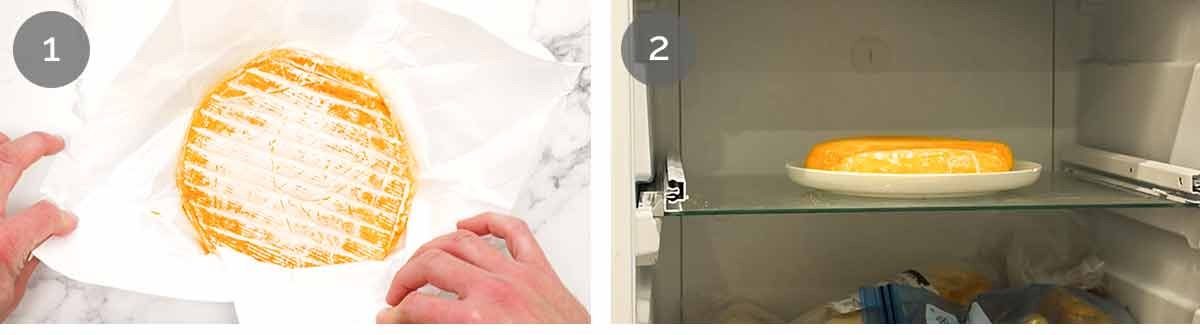
Unwrap the cheese completely, taking off all the packaging.
Place it on a plate and into the freezer for 1 hour, just enough for it to firm up so it holds together well when you are cutting it..
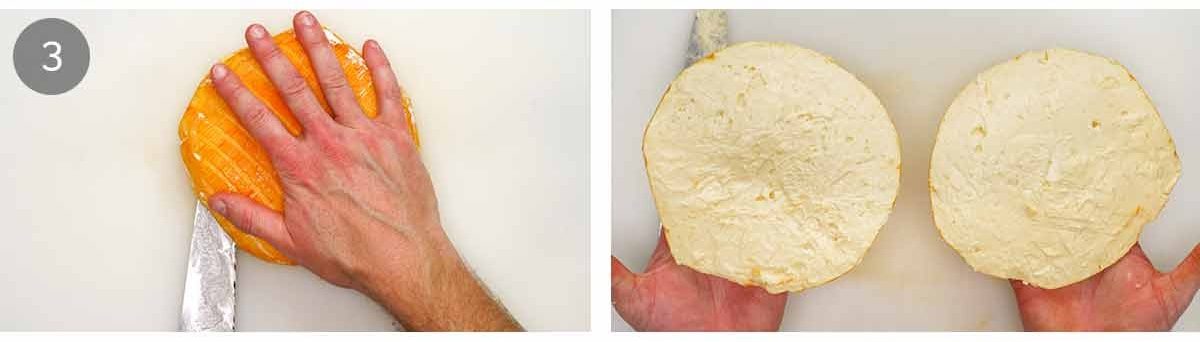
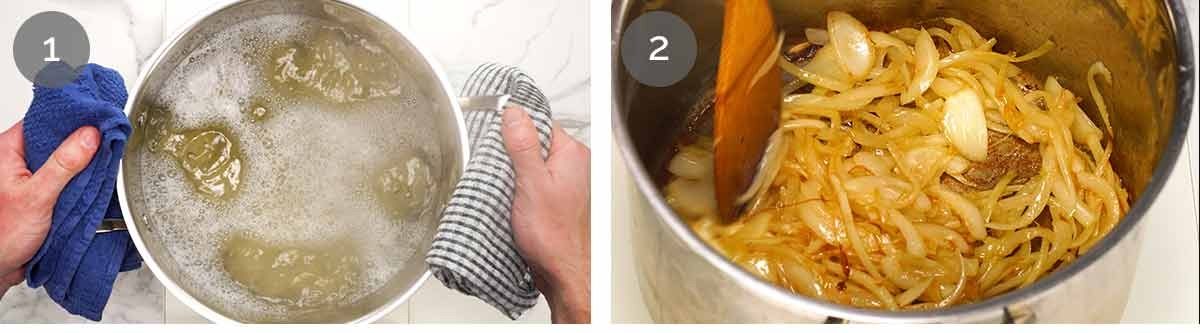
Carefully slice the cheese in half horizontally through the middle with a sharp knife, so you end up with two thinner rounds, rind on one side and the creamy cut side exposed on the other.
2.Cook, assemble and bake
Now that the cheese is sorted, everything else comes together in one pot before going into the baking dish.
Cook the potatoes – Place the cut potatoes in a large pot (mine is 7 litres / quarts) and cover with cold water (2cm / 0.8″ above the potatoes). Add salt, bring to a simmer, and cook for 15 minutes until just tender. A knife should slide in easily with barely any resistance, but the potato needs to still be firm enough to hold its shape, you don’t want them breaking apart.
Drain and leave in the colander until needed, this lets any extra moisture to drain and steam off so the potatoes stay dry rather than watery once baked.
Why start with cold water? It helps the potatoes cook evenly. Starting with boiling water can make the outsides soften before the centres are cooked.
Cook the onion – In the same pot, melt the butter over medium-high heat, then add the onion and cook for 5 minutes, stirring regularly with a wooden spoon, until softened and start to colour.
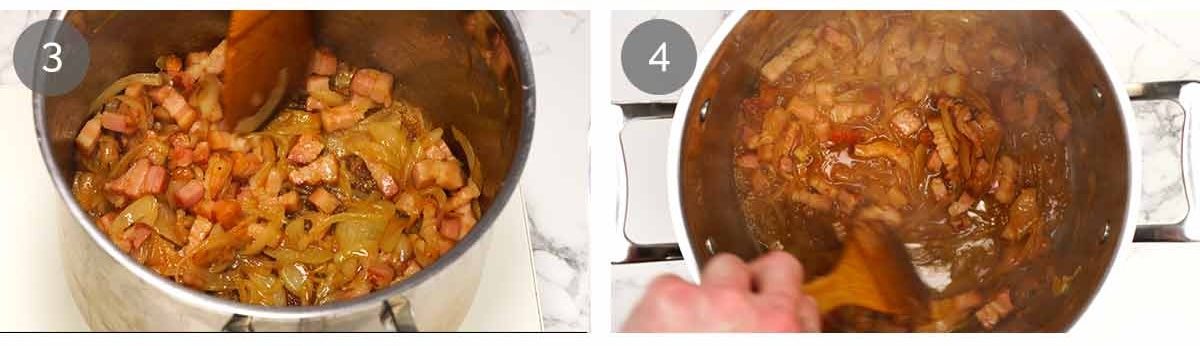
Add the bacon and cook for a further 5 minutes, stirring regularly, until the bacon is lightly browned and the onion is beautifully golden. If things are browning or catching on the bottom of the pot too quickly, lower the heat a little.
Pour the wine to deglaze, and let it reduce for 30 seconds, scraping the bottom well to loosen all the fond into the wine (those tasty browned bits stuck to the base). There is so much flavour hiding down there, don’t waste it!
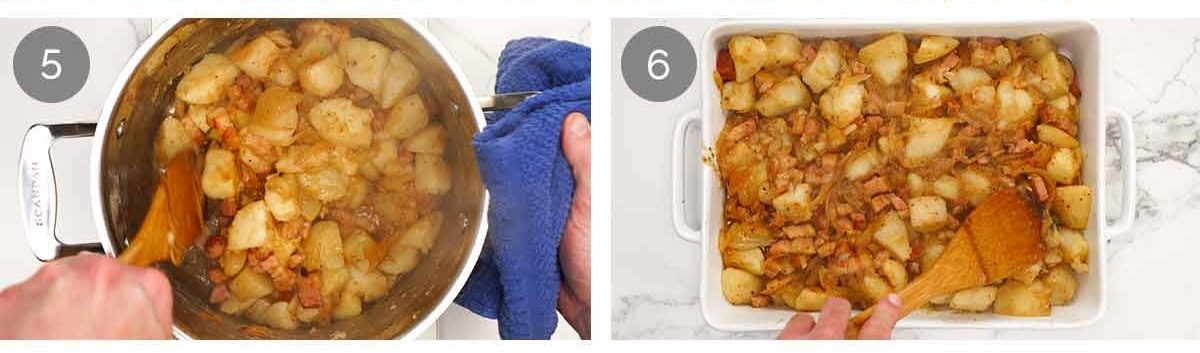
Add the potato back into the pot with the salt and pepper. Stir gently, just enough to combine, taking care not to break up the potato pieces.
Transfer the mixture into a baking dish and spread it out into an even layer. The dish I am using is 30 x 25 x 7cm / 12″ x 10″ x 3″.
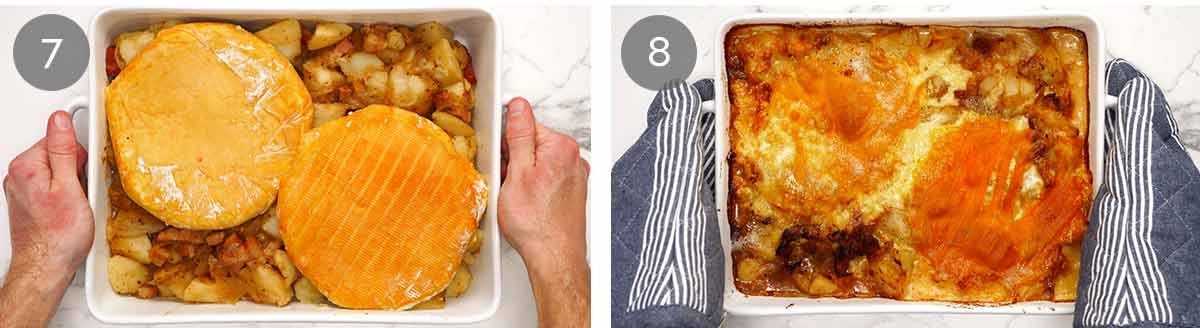
Place the two halves of reblochon on top, rind side up.
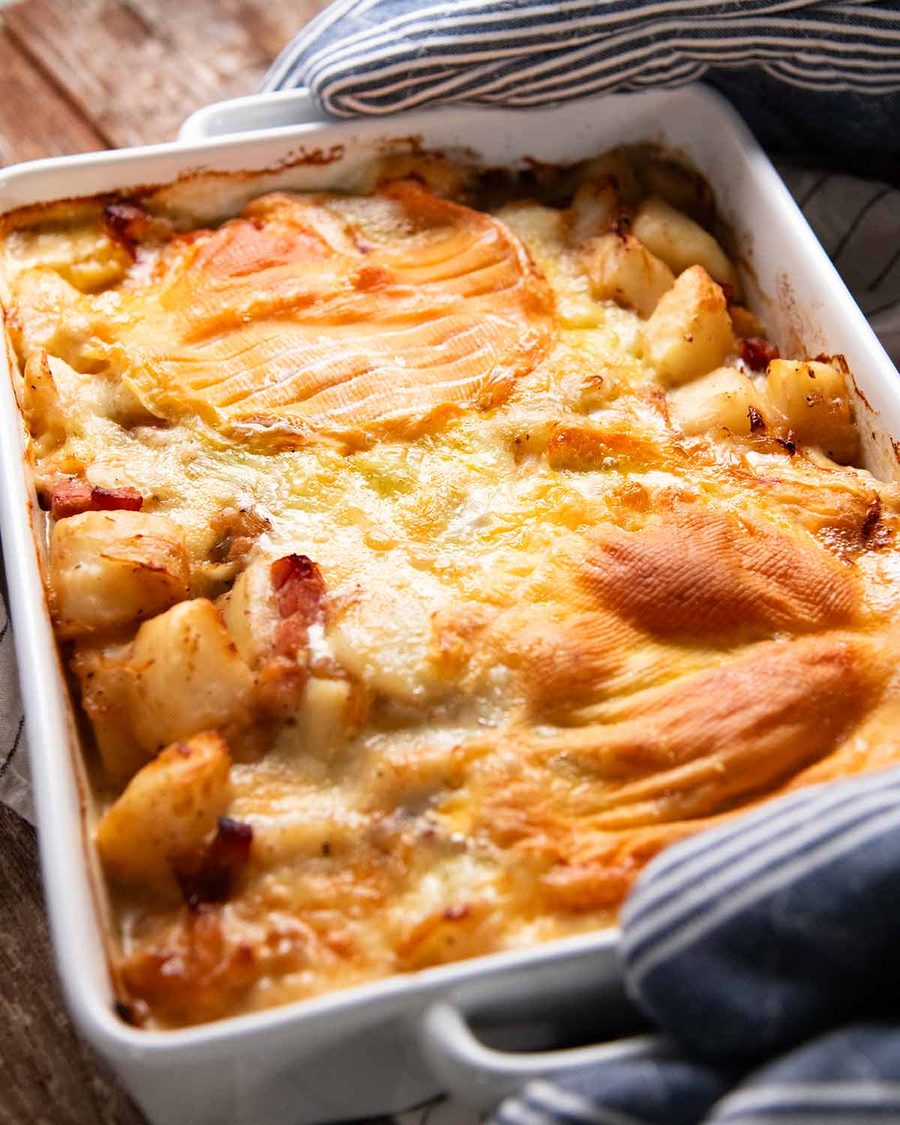
Bake at 200°C / 390°F (180°C fan-forced) for 30 minutes, until the reblochon is completely melted, bubbling around the edges and beautifully golden on top. As it bakes, the melted cheese becomes the sauce of the dish, coating every piece of potato in rich, creamy goodness.
Rest for 5 minutes before serving, if you can wait that long!
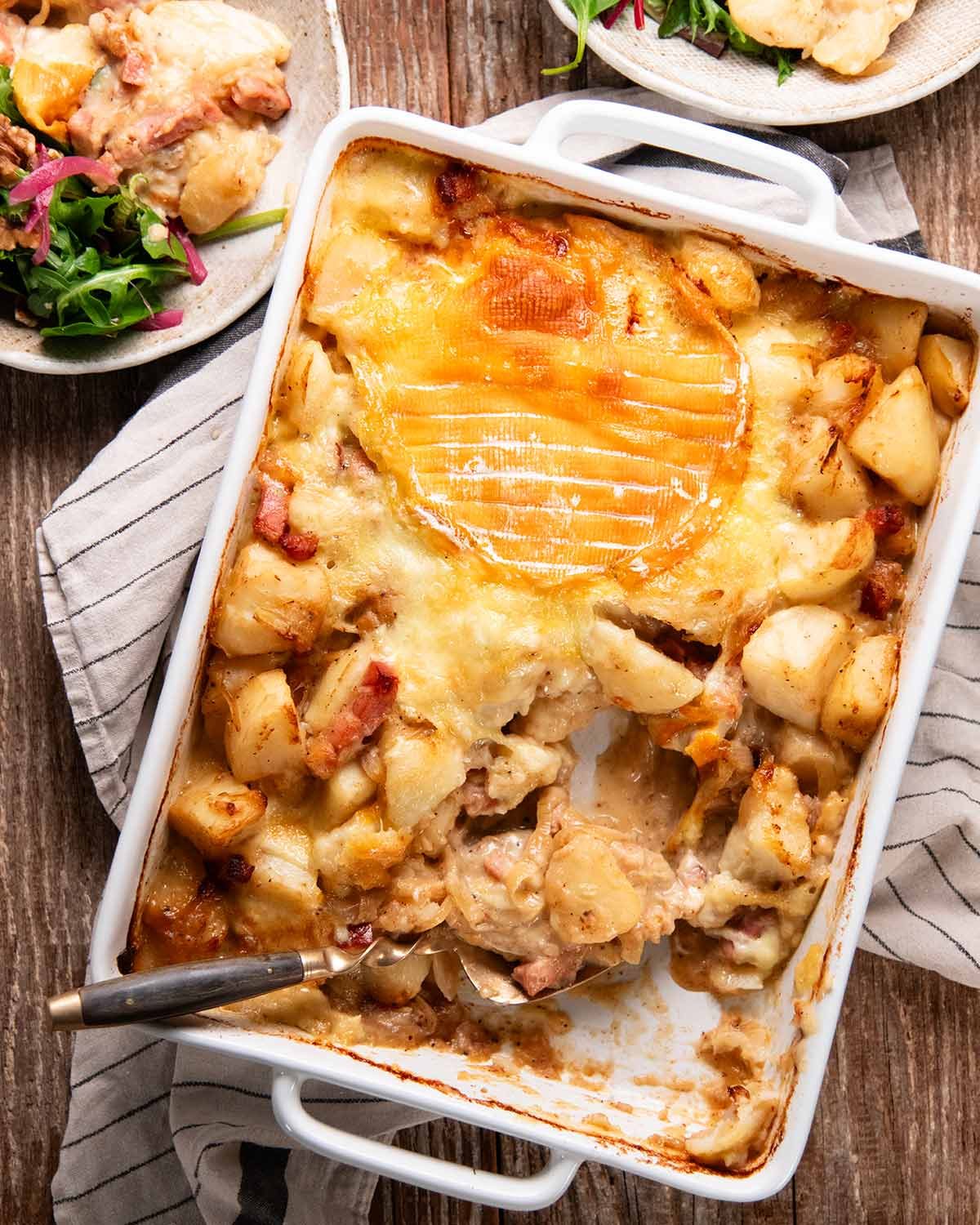
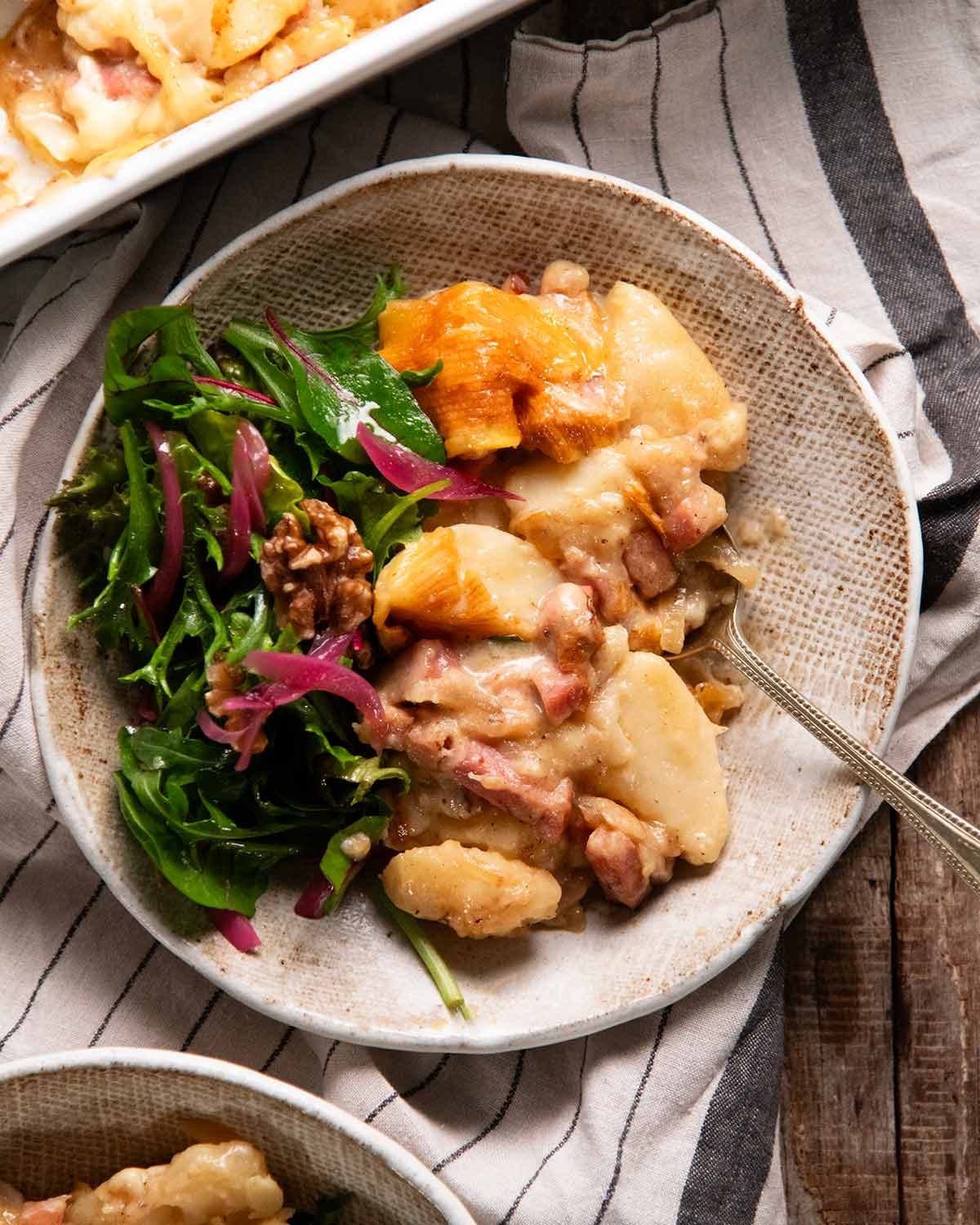
How To Serve Tartiflette
Tartiflette is served in the cooler months as a simple main meal in France, usually with just a salad on the side and a glass of crisp white wine. The dish is so substantial and rich that it doesn’t need any extra sides. Try the French Bistro Salad or any fresh leafy salad with a French Vinaigrette, or sautéed Green Beans.
It could also be served as a side dish, like you would Potato Dauphinoise, as part of a banquet though you don’t see this done in France. If I came across Tartiflette on a buffet, I would ignore everything else and just pile my plate full of that!
Have you ever eaten Tartiflette, or is this the first time you’ve heard of it? I’d love to hear in the comments below. Bon appetit! – JB.
FAQ – Tartiflette
Reblochon is the proper cheese for tartiflette, but unfortunately genuine Reblochon is difficult to find in countries such as Australia and the US. Look for a soft washed-rind cheese that melts well. Préféré de Nos Montagnes and Délice du Jura are excellent substitutes, as are Taleggio or Saint-Nectaire. or other washed rind cheeses.
If using a washed rind cheese that is cut into wedges rather than a whole wheel like the Reblochon-style cheeses pictured in the post, still cut the cheese in half horizontally then place it on the surface of the potatoes (see photo below). If you find it is too hard to cut the cheese in half, you could cut into chunks instead, like pictured below. The goal is really just to get as much coverage on the surface of the potatoes as you can so you get even dispersion of the melted cheese throughout the potato.
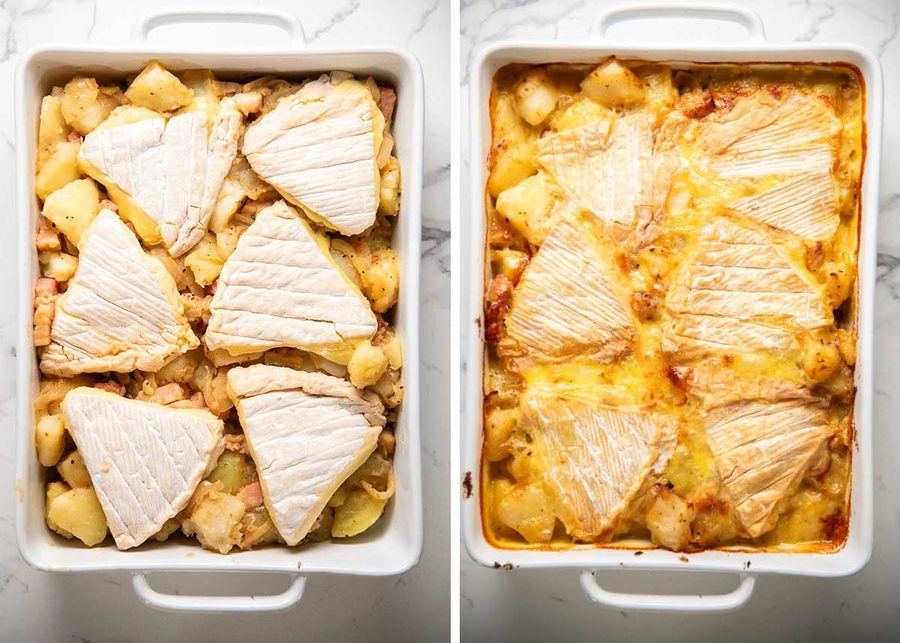
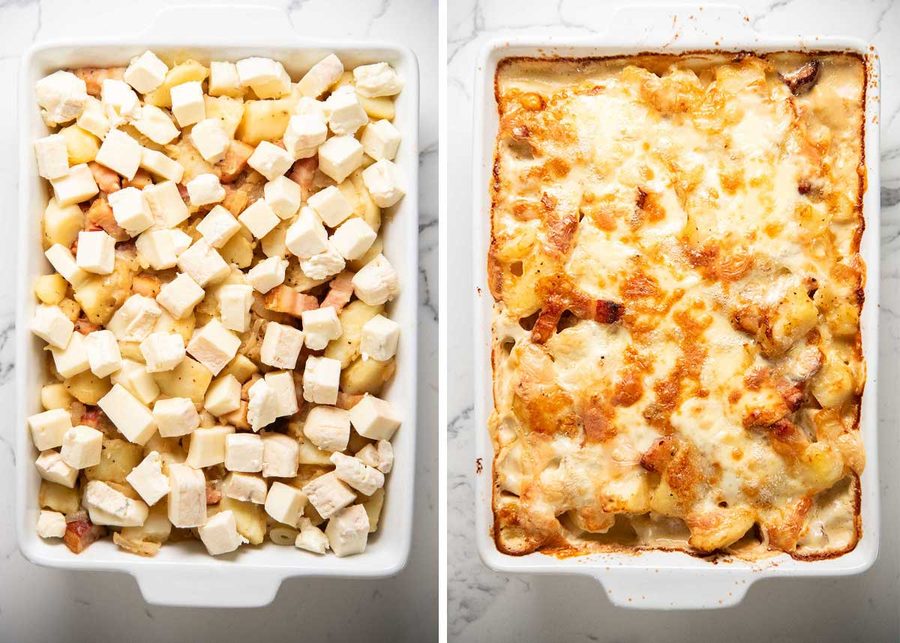
No! Keep the rind on. Cut the Reblochon horizontally through the middle, then place both halves on top of the potatoes rind side up. As it bakes, the cheese underneath melts down into the potatoes while the rind becomes beautifully golden.
Reblochon is naturally very soft and creamy, which makes it difficult to slice neatly in half when fresh. An hour in the freezer firms it up just enough to make cutting much easier without actually freezing the cheese solid.
I use Sebago potatoes, the dirty/brushed or common washed potatoes you’ll find at Australian supermarkets. They become beautifully tender while still holding their shape. Avoid waxy potatoes such as red or new potatoes, which stay firmer and don’t absorb the flavours of the dish quite as well.
Traditionally, tartiflette is made with a dry white wine from the Savoie region, such as Jacquère or Roussette. They can be difficult to find outside France, so Chardonnay is a great substitute and my favourite wine for cooking. There’s no need to use an expensive bottle, save the good stuff for drinking!
Yes. Use a dry non-alcoholic white wine in place of the regular wine. It will still give you some of the acidity and flavour that the wine brings to the dish.
Yes, though Tartiflette is at its best freshly baked. You can assemble it ahead, cover and refrigerate, then bake when needed. If baking it straight from the fridge, allow a little extra oven time because the whole dish will be cold. Go by appearance, it’s ready when the cheese is completely melted, bubbling around the edges and beautifully golden on top.
Watch How To Make It
Hungry for more? Subscribe to my newsletter and follow along on Facebook, Pinterest and Instagram for all of the latest updates.
Tartiflette
Ingredients
- 500g / 1 lb reblochon cheese or any washed rind cheese (see Note 1 for brie option)
- 1.5kg / 3lbs potato, starchy – peeled, cut into 2.5cm / 1" cubes (Note 2)
- 1 tbsp cooking salt / kosher salt , for the potato cooking water, halve for table salt
- 60g / 4 tbsp unsalted butter
- 2 brown onion , halved then sliced 3mm / 0.1" thick
- 350g / 12oz bacon block (or speck) , rind removed if any, cut into 2.5 x 0.8cm / 1″ x 0.3" thick batons – substitute thick cut bacon (Note 3)
- 3/4 cup white wine – Jacquère or Roussette from Savoie if you can else any dry white wine, I use Chardonnay (Note 4)
- 3/4 tsp cooking salt / kosher salt , halve for table salt
- 3/4 tsp black pepper
Instructions
Abbreviated recipe
- Boil potatoes 15 min, drain. Sauté onion in butter 6 min, add bacon, cook 6 min. Deglaze with wine, reduce 30 sec. Add in potato, salt and pepper. Transfer to baking dish, top with halved reblochon (rind side up). Bake 30 min at 200°C / 390°F (180°C fan). Rest 5 minutes then serve.
Full Recipe
- Cut Reblochon – Reblochon is normally very soft, so it needs to be firmed up before cutting. Place the whole cheese in the freezer for 1 hour then use a sharp knife to slice it in half horizontally through the middle. You should end up with two thinner rounds, each with rind on one side and the creamy cut side exposed. If using another types of washed rind cheese, still do this step. (Note 1)
- Preheat oven to 200°C / 390°F (180°C fan-forced).
- Cook potatoes – Place the cut potatoes in a large pot (mine is 7 litres/quarts) and cover with cold water (2 cm / 0.8" above the potatoes). Add salt, bring to a simmer, and cook 15 minutes until soft. A knife should easily slides through without resistance, but the pieces are still holding their shape.
- Steam dry – Drain the potatoes and leave in the colander until needed so they steam dry.
- Cook onion – In the same pot, melt the butter over medium-high heat then add onion and cook for 5 minutes stirring regularly with a wooden spoon.
- Bacon – Add the bacon and cook for 5 minutes, stirring regularly until it is lightly browned, and the onions are beautifully golden.
- Wine – Add the white wine to deglaze, and reduce for 30 seconds, scraping the bottom to loosen and dissolve all the fond (those tasty browned bits stuck to the base) into the wine, there’s loads of flavour in there!
- Add the potato back into the pot with the salt and pepper. Stir gently just until just combined.
- Assemble – Transfer the potato mixture into a baking dish (30 x 25 x 7cm / 12" x 10" x 3") and spread it out into an even layer. Place the two halves of reblochon on top, rind side up.
- Bake for 30 minutes until the Reblochon is completely melted, bubbling around the edges and beautifully golden on top. Rest for 5 minutes before serving.
Recipe Notes:
- Australia– Sebago (dirty/brushed or the common washed potatoes sold at supermarkets).
- US– Russet, Yukon Gold
- UK – Maris Piper, King Edward
Nutrition Information:
Life Of Jaffle
Someone in this house was very very naughty and ate a lot more Tartiflette than he was supposed to, so a walk was in order to make up for it.
Jaffle, ever the opportunist, decided to tag along too. 😁

Thanks for replying. I will stick to potato dauphinoise then as I love the cheeses used in that recipe.
I actually tried this during a five day stay in the Savoie region in December! Hard to describe how delicious this dish is… Enjoyed it several times and now I’m excited to make it myself! Wonder if I can bring back a small wheel or two of the cheese after my next visit to France?
Hi bell, there’s nothing like eating tartiflette in Savoie in winter! I can understand why you went back for it several times. As for bringing Reblochon home, just make sure to check your country’s customs rules first.–
Yes, I checked. No way US will allow unpasteurized anything! I have good options. Thanks for the head’s up – headed to Lyon in November—more food to discover!!!
Hello, French person here! I have brought back some very similar product from France. Just make sure to check in the ingredients that the cheese is pasteurised and have it vacuum sealed when you buy it. It worked for me perfectly. I declared it at customs on my way back to Australia and didn’t have any issues. I did the same with a quarter wheel of raclette cheese 😂
What a great cold Saturday night recipe base. I added some beans,shredded cabbage and mushies to the mix along with some turmeric, 5 spice and thyme. I used what I had in the fridge cheese wise; a couple of wedges of local Brie and topped it up with some shredded tasty. Wow. got kudos from the “Boss” too.
Hi Gaven, now that is quite the tartiflette remix! 😂 I love that you made it your own with what you had in the fridge. 🙂
J.B. I love you and your recipes, but I fear this one would kill me!
Must confess my jeans are a little snugger these days….. 😩😂
Thank you Jane! And don’t worry, you’ll be fine!
Jaffle ate so much tartiflette, because it’s a delicious French dish, JB! Can’t wait to try it in the last throws of winter!
Thank you Steve! I hope you like it 🙂
This looks and sounds amazing JB! Can’t wait to give it a go!!
Thanks Maureen!
This raises my cholesterol level just looking at the pictures. Extra statins will be required.
Hi Joe, I think this is one of those recipes where it’s best not to look too closely at the nutritional information! 🙂
OK, this cheese monster in Western Australia cannot wait to attack this dish!!!!
Don’t wait too long Wendy!
This looks DIVINE! As it is currently mid-August with heat indices over 100 in my neck of the woods…I won’t be making his for a hot minute…but it will haunt my food daydreams until fall that’s for sure.
One can never have too many potato/cheese/bacon recipes.
Hi Jenna, I think tartiflette can definitely wait until the heat index drops a little! But I completely agree, there is always room in life for another potato, cheese and bacon recipe!
Argh JB what have you done?! I’m a food loving Kiwi now living in middle of nowhere Nebraska and a quick Google search has resulted in no suitable cheese options for me! :'( Nevertheless the hunt must continue because this dish looks amazing and I must have it in my belly stat! Thanks for the great recipe. Love all your work Team Recipetin!
Sorry! I may have sent you on a bit of a cheese mission! But don’t give up, hopefully you can track down a substitute. The hunt will be worth it, I promise! Thanks for the lovely words and good luck from all of us!
Worst case scenario, just use a ripeish Brie, and you’ll get a bit of earthiness off the rind.
The first couple of times I made it I used Brie or Camembert.
Cheese and potatoes how can you go wrong? Although I can’t get Reblochon cheese, I have been told that there are a few Quebec cheeses that that I can use as a substitute. As soon as the weather gets cooler, will definitely try.
Thank you Nancy, I think it’s a good call to wait until the weather is more tartiflette friendly. 🙂
Caption cracked me up! You & Jaffle def running neck and neck on the cuteness meter.
Haha thanks Debra!
this looks amazing! I live in the US; the changes of me finding Rebochon are nil. What might be a good substitute, please? Also — yukon potatoes? russet? ?? thank you! can’t wait till it cools down here and I can try this!
All of the answers to your questions are in the notes.
Hi Nicole, all the answers of your questions are included in the post. I hope that helps 🙂
thank. you. can’t wait to try it (when it cools down!!!!!). love your recipes, JB & Nagi. thank you sooooo much for keeping cooking interesting and fun.
As a French, Tartiflette is my very favourite dish ever! I once had my Maman make it for me in a heatwave in August before leaving to studio in the US for a year… :,) Merci JB for sharing this joyous, glorious, deliciously cheesy recipe with the world! Even adapted with different cheeses, I’m sure it will bring a lot of joy.
Secret family tip: make it the day before and then bake it on the day, so that the potatoes soak the flavours from the sauce!
Now that is dedication, tartiflette during an August heatwave! I love that story. And thank you for sharing the family tip too! JB
Could this be made with brie or camenbert? Also (sorry JB) couldbthe onions be left out or subbed with onion powder? Our budget wouldn’t stretch to fancy cheese and my hubby hates onion!
Brie or Camembert will both work, we do have a brie dauphinoise potatoes recipe if that helps. And yes, you can leave the onions out altogether. I’d actually skip them rather than use onion powder. It won’t be quite the same tartiflette, but it will still be very delicious!
Beautifully expressed, Melinda!
I could not agree more!
Kindly,
A Lass from The Canadian Prairies.
This looks amazing, can’t wait to try it in the cooler months!
Thank you Gemma!
I’m going to try this with Highland fine cheese in Scotland. Their washed rind cheese no joke are called minger and fat cow. My favourite is potatoes boulangère right now. Would love a recipe for them at some point.
Seconded!
Pommes Boulangères is a good one Margaret. Noted!
Hey JB, thanks for this recipe. I’m an American living in Dijon and I LOVE tartiflette! I also love that you’re giving us these authentic French recipes to try. What I get most confused about here is all the different kinds of potatoes used for specific things here. Is there an easy way to keep it straight in my head so that I don’t freeze like a deer in headlights when I’m in the grocery store? Thanks again!
He did put a potato selection in the notes mate – I live in The Macedon Ranges in Victoria Australia and we have local potato farm nearby – if you cook you know potatoes starchy or not starchy but I bet most spuds will do – I’d go with a potato that’s for chips 🧡💛 we love JB , Nagi & Jaffle
He did put a potato selection in the notes mate – I live in The Macedon Ranges in Victoria Australia and we have local potato farm nearby – if you cook you know potatoes starchy or not starchy but I bet most spuds will do – I’d go with a potato that’s for chips 🧡💛 we love JB , Nagi & Jaffle
Hi Kia, I wrote potato specifications in the ingredients and recipe card notes sections. I hope that helps. 🙂
Tartiflette sounds fabulous!!! I will be making this recipe soon even though we are having 100 degree days here frequently.
Thank you for your comment Barb 🙂