
Pierogi Ruskies: Potatoes. Cheese. Butter. The Polish are genius – this is dumpling heaven! A great weekend project – cook some now, freeze some for later. They cook from frozen!!

A Pierogi Ruskie recipe
I’m so excited to be bringing you this Pierogi recipe! I’d eat them every day if they didn’t tip the scales in the wrong direction. 😭
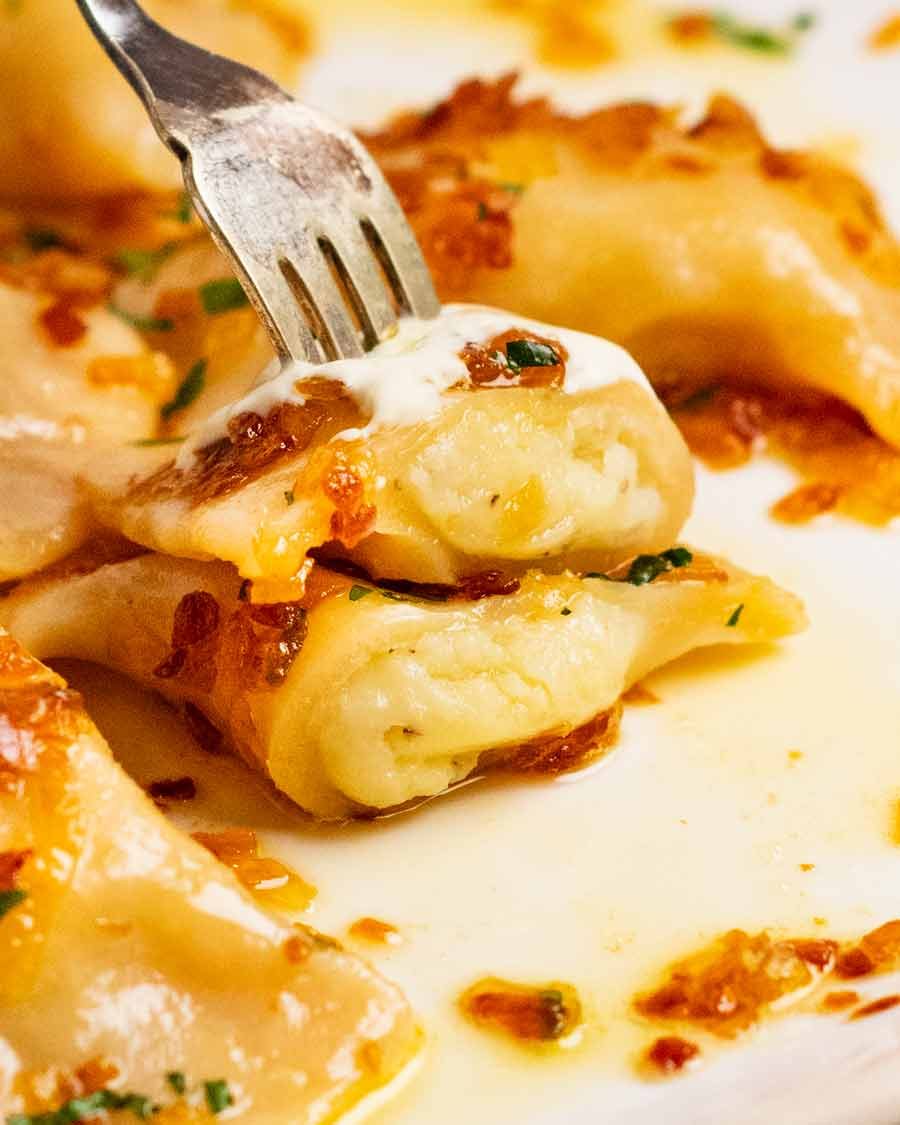
Even if you haven’t tried a Pierogi before, all you need to know is that these ones are cheesy, creamy mashed potato filled dumplings served with an intensely butter onion sauce.
In other words, it is every Cheese-Lovin’ Carb Monster’s Dream come true, and she who is the self appointed Head Priestess of this Club was literally in mind-boggling ecstasy when faced with a plate of these.
They are, to say the least, one of the most delicious things I’ve eaten this year!

What are Pierogi?
Pierogi are Eastern European stuffed dumplings that are usually boiled. As with many traditional foods, there are regional varieties with fillings ranging from sweet to savoury, meat to meatless.
This potato and cheese-filled Pierogi recipe I’m sharing today is a meatless kind popular in Poland. The filling? Cheese! Potato! Butter! Even if you’ve never had one before, these three words already mean you know you’re going to love it!
What they taste like: Pierogis are heartier and heftier than Asian dumplings like gyoza and Chinese potstickers. The dumpling wrapper is thicker and the filling is often rich. The dumpling itself is also bigger and heavier, and often topped with a sauce of melted butter. Tt may not be the lightest of meals but it will be one of the best things you eat this month!!
Ingredients in Pierogi
Very, very few!
THE Pierogi filling
It’s essentially cheesy, buttery, creamy mashed potato. See authenticity note below the photo on the cheese, and why it was important for me to make this recipe accessible to “everyone”!
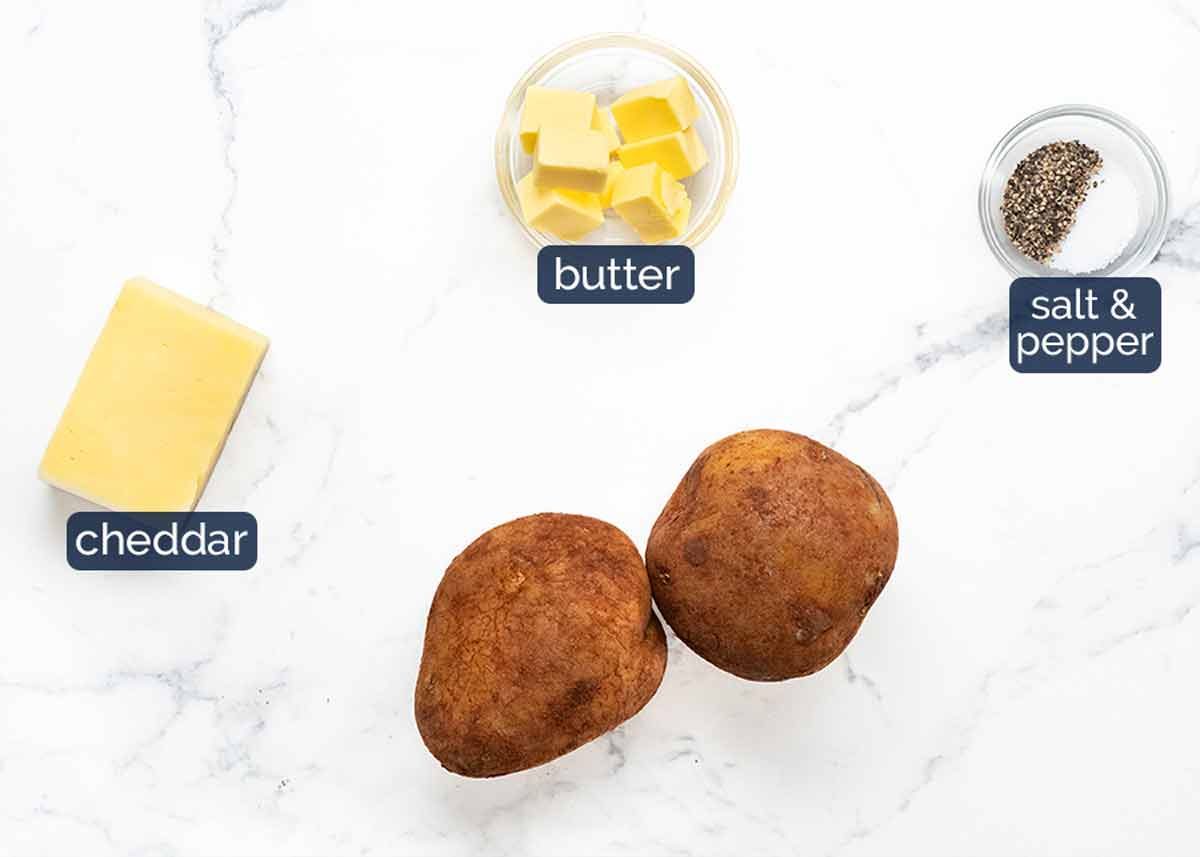
Potatoes – Use all-rounder potatoes so they mash up fluffy and creamy. The most common potatoes at regular stores will be fine – they’re stocked because they’re great all-rounders.
Australia – Sebago (the dirt brushed potatoes sold everywhere) are perfect, Desiree are great too. US: Yukon Gold, russet, UK: Maris piper, King Edward.
Cheese – I use cheddar but any good melting cheese you’d happily put in your grilled cheese is fine. Give mozzarella a miss. While it melts great, it doesn’t have enough flavour.
Authenticity note – Pierogi is traditionally made with quark, a mildly tangy European cottage cheese. Quark is not something I’ve seen frequently in Australia. Cottage cheese is probably the best substitute. But shredded cheese, as you can imagine, makes a delicious alternative – imagine it melted throughout creamy mashed potato!
I opted to use regular cheese because I want this recipe to be as accessible as possible so many people can experience the greatness that is Pieorgis.
Butter – Use unsalted so we can add the right amount of salt.
Pierogi DUMPLING DOUGH
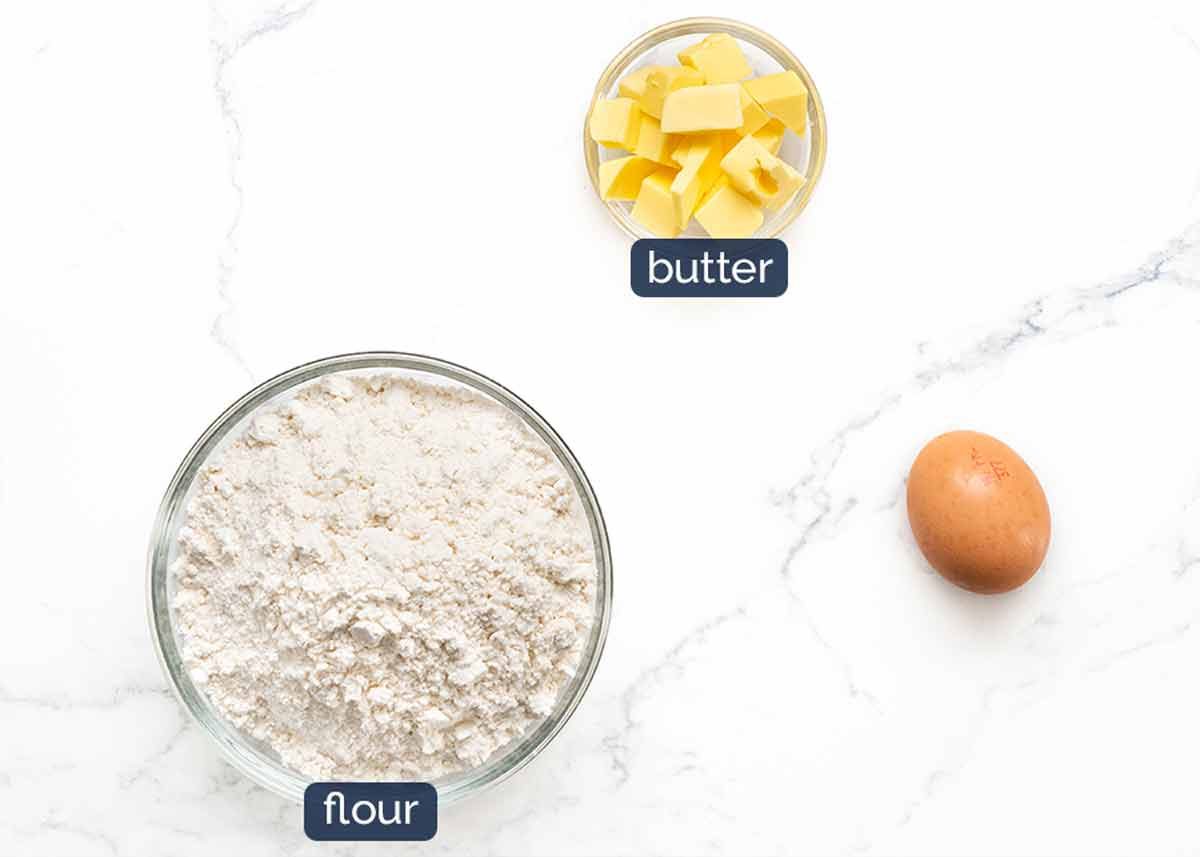
Flour – Just plain / all-purpose flour.
Large egg – From a carton labelled “large eggs” (they should weight around 55-60g/2 oz).
Butter – Melted into the water that I accidentally left out of the phot. 🙂
ONION BUTTER SAUCE
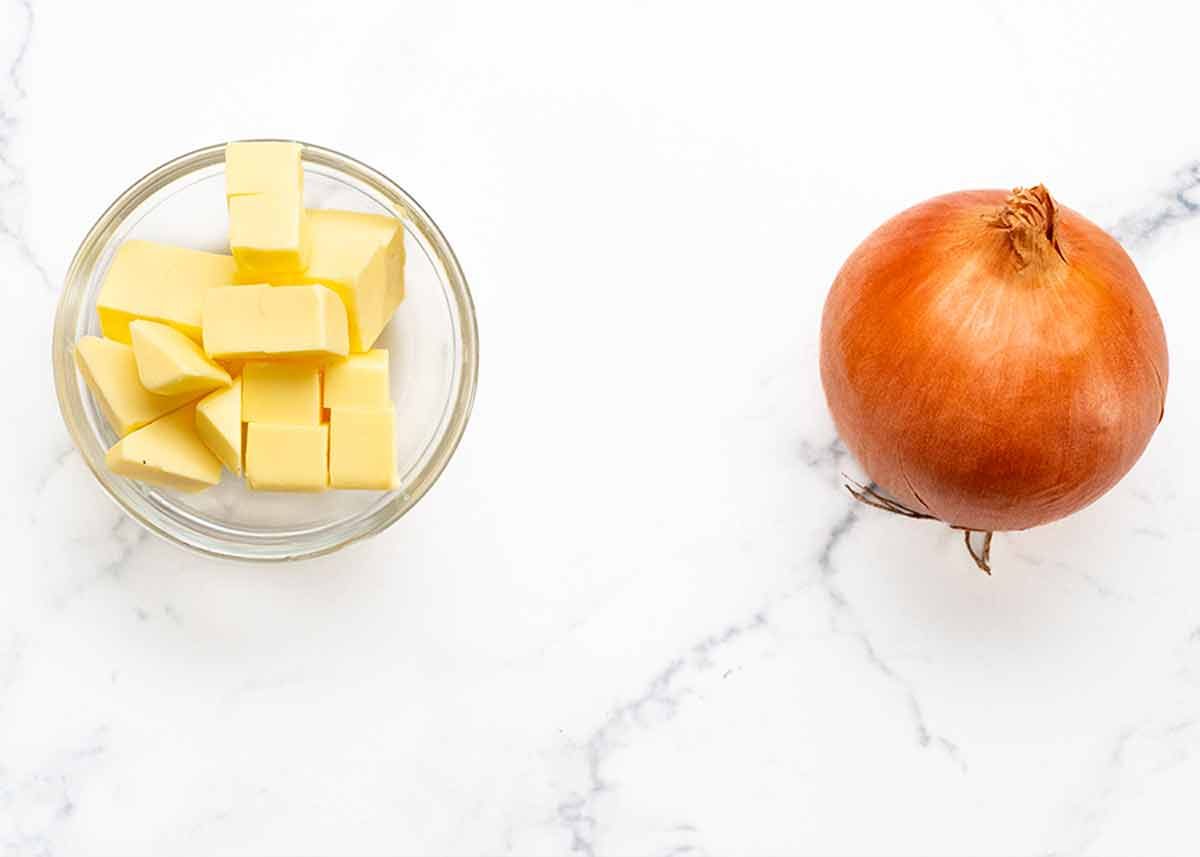
You could serve the Pierogis will just melted butter and you’d swoon. But it’s even better with a sautéed onion sauce which is common with traditional Polish Pierogis.
How to make Pierogi
Pierogis are easier to wrap than gyoza and potstickers. Because Asians like pleating – which can take practice to master. The Polish just press to seal. Much simpler! – I’m a big fan 🙂
HOT TIP: Got a Pierogi itch that needs scratching but homemade wrappers are out of reach? Use store-bought round Asian dumpling wrappers instead. The wrappers are thinner but it works a treat!
1. CHEESY POTATO FILLING FIRST
Make the filling first because it needs 1 1/2 hours to fully cool, during which time you’ll have the dough rolled out and cut, ready to fill!
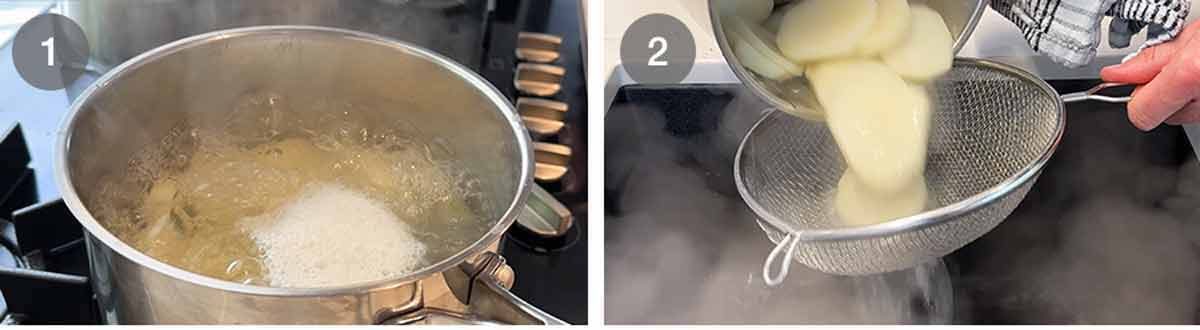
Boil potatoes in salted water, starting with the potatoes in cold water. Why? Because otherwise the outside of the potatoes cook too much and start to crumble before the inside is cooked.
Drain potatoes.
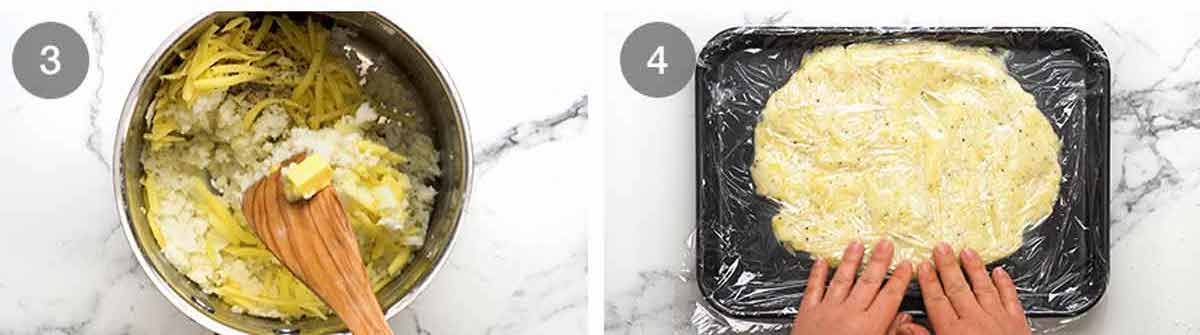
Mash & mix – Pass the potatoes through a potato ricer or mash using a regular potato masher. Then mix in the butter, cheese, salt and pepper. The cheese won’t melt – it melts when the pierogis is boiled!
Cool – Spread out on to a tray. Cover with cling wrap, pressing so it is fully in contact, so the filling doesn’t sweat. Cool on the counter (about 30 minutes) then refrigerate until cold (1 hour+). You can do this the day before.
The filling needs to be cold so it doesn’t sweat inside the dough (which would make the dough soggy). It’s also easier to wrap the dumplings because the potato is firm.
2. how to make pierogi dumpling DOUGH
You could use your stand-mixer but I enjoy the leisurely process of hand-kneading this dough. It’s easy to manage because it’s a small amount and the dough is soft. Plus, hand-kneading is somewhat satisfying, and you can (smugly) tell everybody fortunate enough to eat one of these – I made these myself with my own hands. (You know I do!)
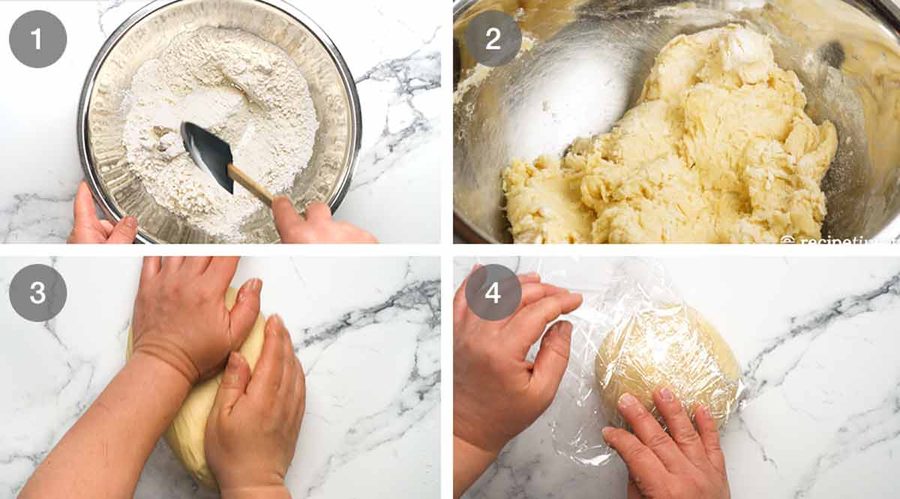
Dry – Whisk the flour and salt in a mixing bowl.
Add wet – Make a well in the centre. Then add melted butter with warm water plus the egg. Mix to combine using a spatula – it will be a rough, shaggy dough.
Knead – Scrape out onto a lightly floured work surface. Knead for 5 minutes until the dough becomes smooth. Use the bare minimum flour as needed to prevent it from sticking to your hands and the work surface. (Too much flour = drier stiffer dough = more difficult to roll out thinly).
Rest – Wrap with cling wrap and leave on the counter for 30 minutes.
3. MAKING THE PIEROGIS
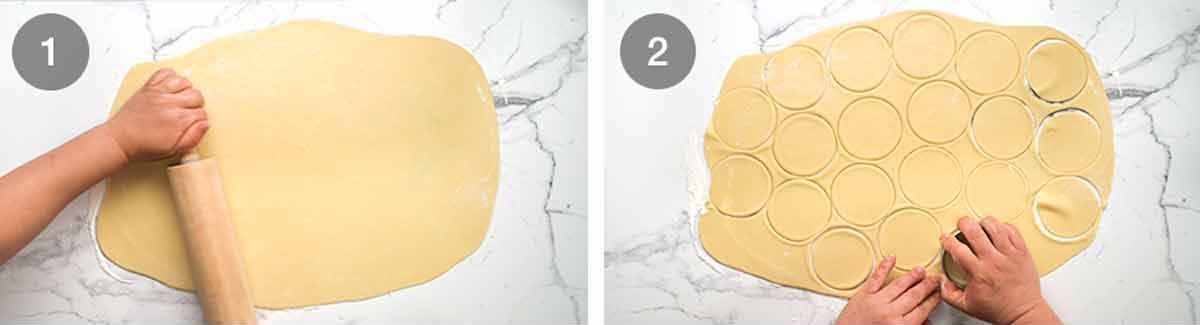
Roll out the dough on a lightly floured surface to 3mm / 1/8″ thickness.
Cut out rounds using a 7.5 cm / 3″ cutter. Do as many as you can, then gather surplus dough into a ball, wrap with cling wrap and set aside to roll out and cut more later.
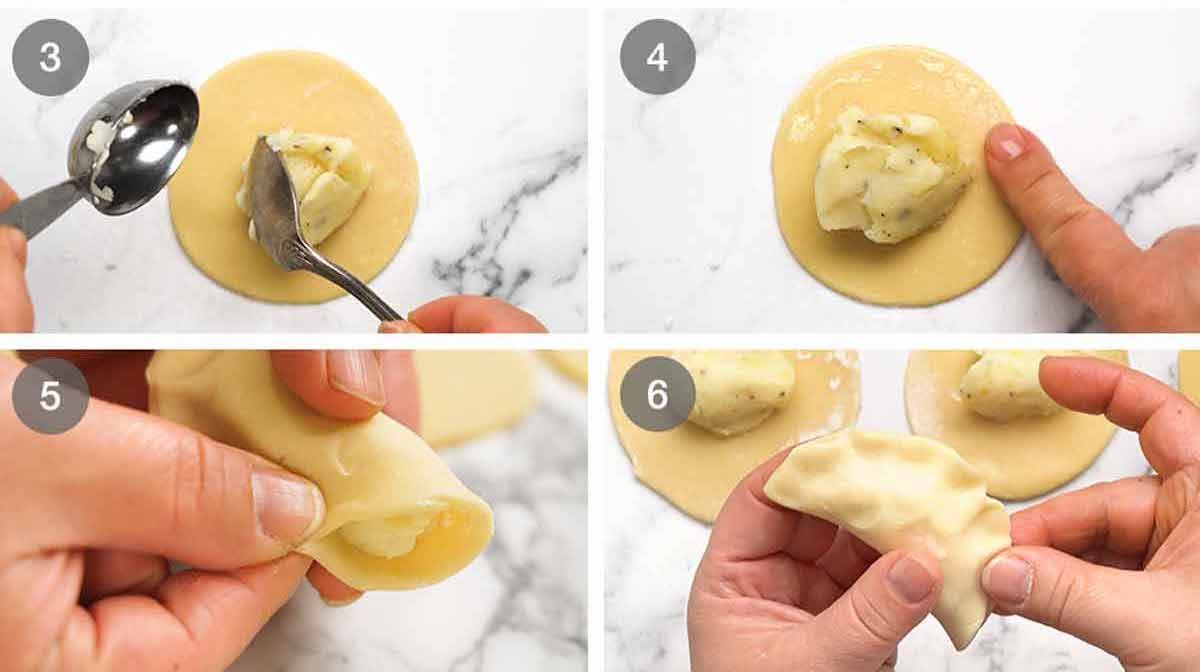
Filling – Place 1 tablespoon of cheesy potato filling in the middle of a round (20g, if you want to be exact!).
Dip finger with water and run along edge of half the circle. This will help seal securely.
Fold dough over to enclose the filling then press the edges together.
Seal firmly by pinching to make slight dents, the traditional look of pierogis.
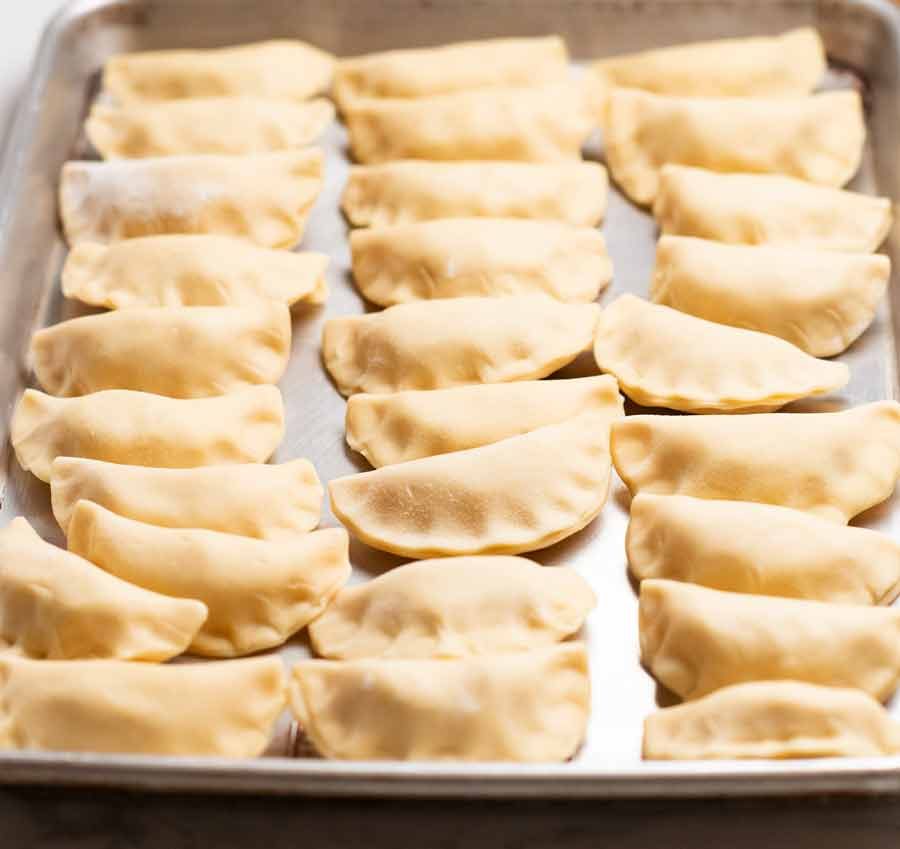
Place them on a lightly floured tray and continue to wrap remaining Pierogi (including rolling out the remaining dough). You should get ~30 pierogis. A nice big batch – cook some now, freeze some for later!
4. HOW TO COOK PIEROGIS
Boil like pasta! Just make sure you don’t crowd the pot. Pierogis needs space to bounce around! I cook 8 in a medium pot, and up to 12 in a wider pot. Tips below for batching cooking larger quantities.
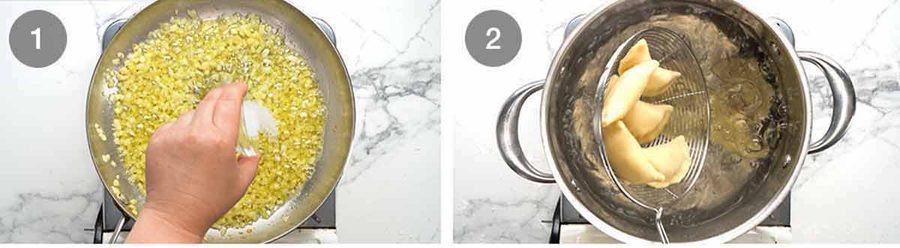
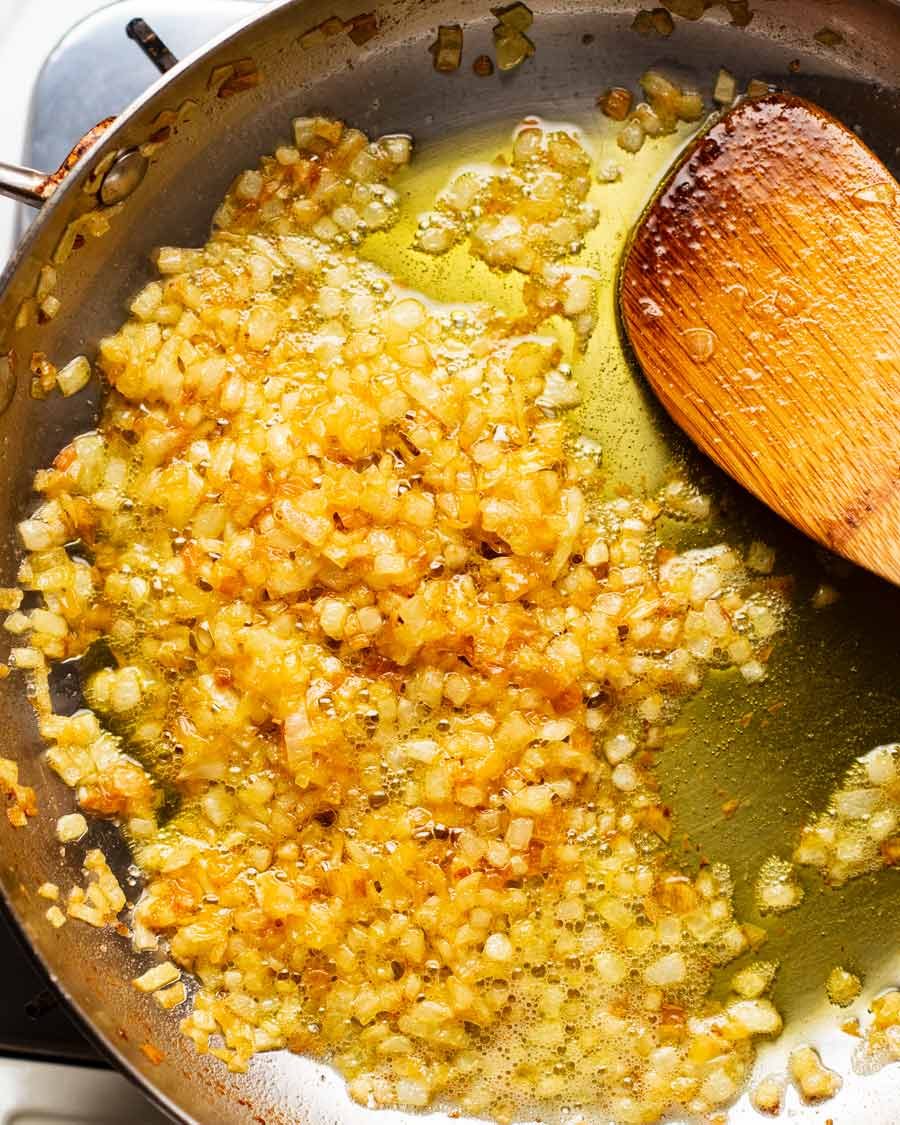
Sauté onion first – Sauté chopped onion in butter until golden on the edges. Then transfer into a bowl or container and use as much or as little as you want for whatever size serving of pierogis you are making. 1 large onion is enough for 30 pierogis because they are only sparingly scattered with onion, like pictured. Cook onion will keep for 5 days in the fridge, or freezer for 3 months.
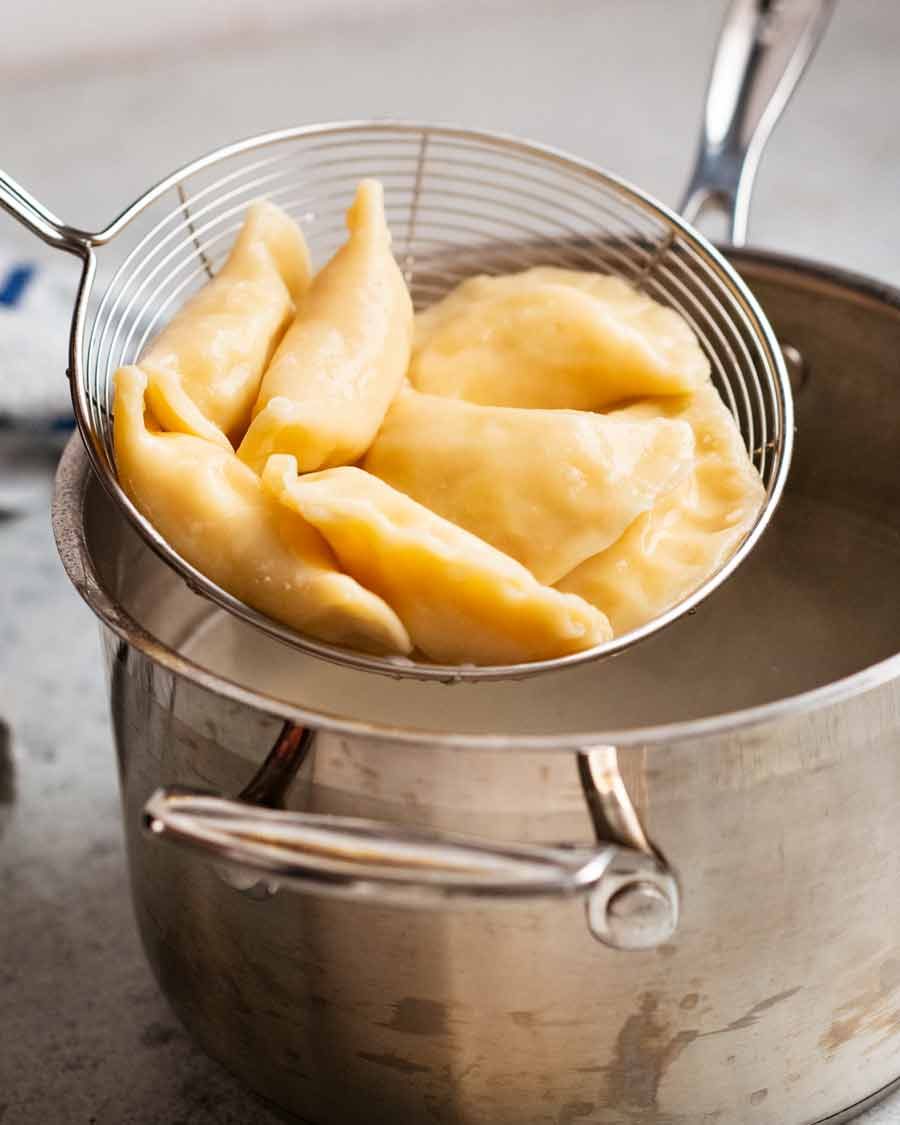
Boil 5 minutes – Bring ~3 litres/quarts of water to the boil with 1 tablespoon of salt. Lower 10 pierogis into the water and cook for 5 minutes, or until they are floating on the surface (they sink at first).
⚠️ As noted above the step photos, don’t crowd the pot else the pierogis will stick together and cook unevenly.
⚡️ It’s important to use salted water so you get some seasoning into the pierogis wrapper as it cooks. Makes it tastier!
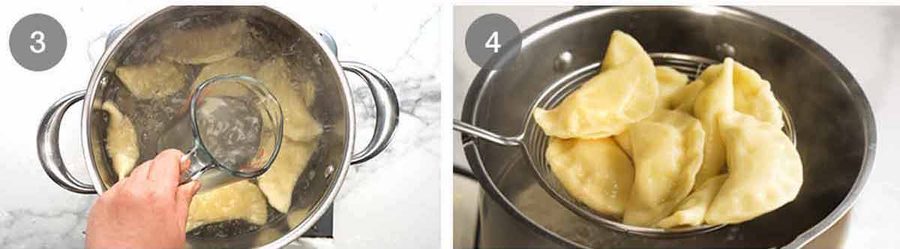
Reserve water – Dip a jug into the water and scoop out 1 cup water. We’re going to use a bit of this water to make the sauce. The cooking water is better than tap water because it’s got starch from the pierogi dough in it which makes the sauce thicken. If you just mixed water + butter together, it stays water.
Scoop out or drain – Then use a slotted spoon to transfer pierogi into a bowl. Or, you can drain in a colander if you are not using the water to cook more.
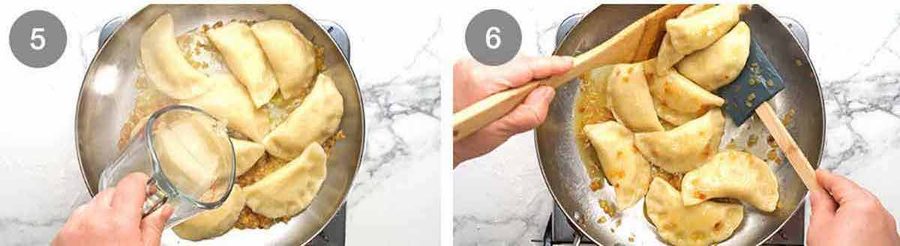
Butter sauce – Using a largish pan, melt 25g butter (1 1/2 tablespoons) over medium heat. Add 1/3 of the onion butter (from step 1) plus the cooked pierogis with 2 tablespoons of the reserved cooking water.
Toss for 1 minute, still on the stove, until the pierogis are coated in the butter sauce. You’ll see it goes from watery (when you first add the water) to thickened so it sticks to the surface of the pierogi.
Larger batch – Just scale up the butter, onion and water. At this stage, it’s easy to eye-ball it. And I wouldn’t discourage the use of even more butter!
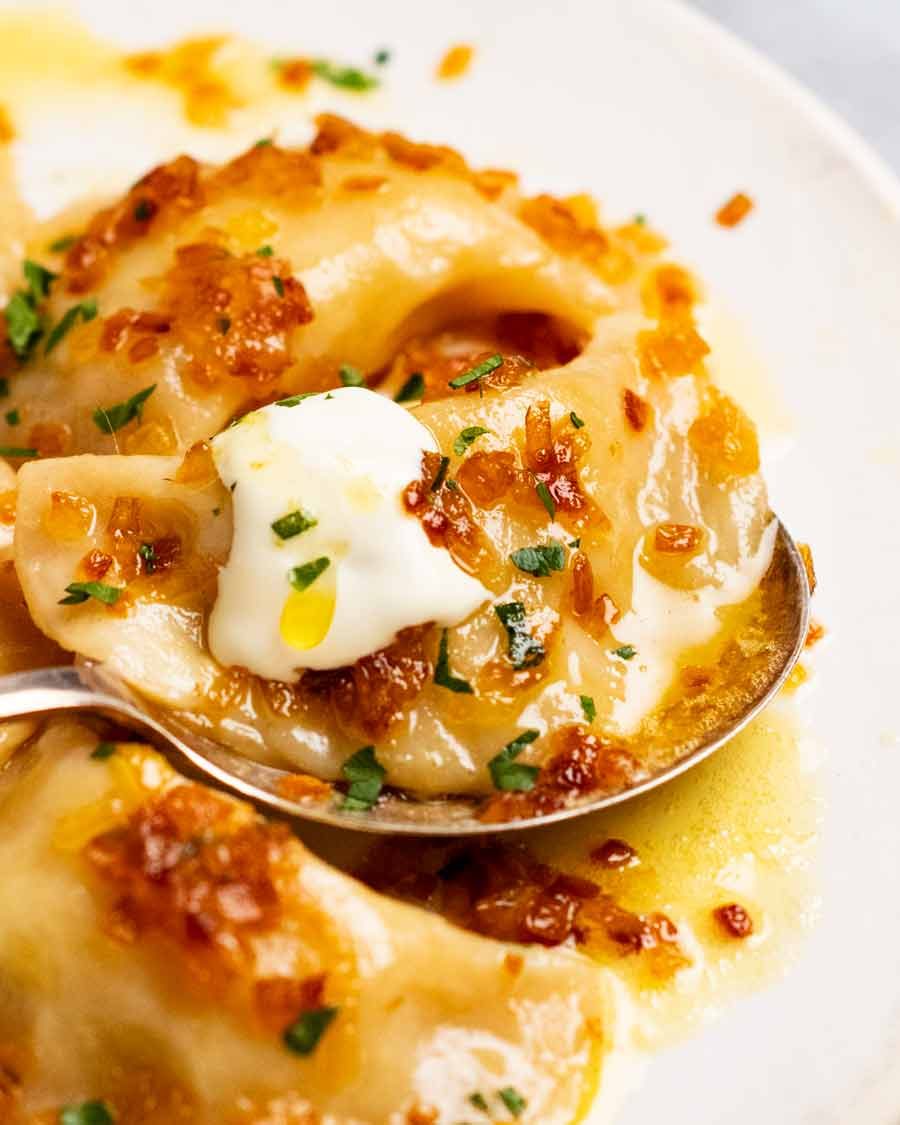
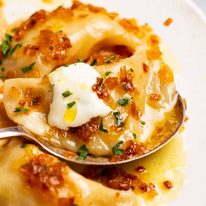
Serve – Slide onto a serving plate, scraping out every drop of butter. Sprinkle with parsley, add a dollop of sour cream. Eat and be happy!
Big-batch cooking of Pierogi
As strange as it sounds to have a whole section on how to cook and serve larger batches of pierogi, there’s actually practical factors that come into play that need to be considered! The reason is because they are quite large – bigger than Gyoza and Chinese dumplings, you can’t boil more than 10 to 12 max per batch, and they need to be tossed in the sauce on the stove.
So the recipe I’m sharing today makes 30 pierogis but provides directions to cook one batch of 8 to 10 (which is a nice amount for 2 people). Leftovers are perfect for freezing – you can cook from frozen!
But if you would like to cook all 30 pierogis, here’s some practical tips for how to do it!
boiling large batches
Pierogis need to be boiled in a single layer else they can get stuck together and the wrapping won’t cook evenly. So you’ll max out at around 12 pierogis in a large home-pot.
If you want to make and serve more, then boil in batches of 12 and spread cooked pierogis on a tray. Once you’ve boiled as much as you want, then drop all of them back into the pot for 30 seconds to reheat before tossing with the butter. Reserve a mugful of the cooking water then drain in a colander.
Large batch butter sauce tossing
For the butter sauce tossing part, you can put in as many pierogis as you can comfortably fit into a large skillet. You could even use a large pot. Just make sure you can toss the pierogis, because that’s how you get a nice coating of butter on them.
Simple method for gigantic batches
If you want to serve all 30 pierogis at the same time, an easy way to sauce them up is to make the sauce separately then douse over the pierogis.
To do this, cook the pierogis per above (ie boil then reheat). Drain well in a colander and transfer into a serving bowl. Melt 70g / 4 1/2 tbsp unsalted butter with 1/3 cup of the cooking water in a small pan on medium heat. Simmer for a couple of minutes until the butter thickens (the starch in the pierogi cooking water makes this happen).
Serving pierogis
Cooking part done, it’s time to enjoy them! A dollop of sour cream adds a lovely cooling, tangy creamy touch that pairs so well with cheesy mashed potato (proof – reader favourite Stuffed Baked Potatoes!). And a little sprinkle of parsley or chives adds a nice touch of green to an otherwise very beige plate.
And as a plate of food that is an unapologetic celebration of three of my favourite food groups – butter, cheese and potato – a perky fresh side of greens would be a nice accompaniment. Even this self-confessed Cheese Lovin’ Carb Monster needs something fresh to cut through all that richness! Try a classic light vinaigrette with leafy greens or any steamed vegetables.
Hope you love this as much as we do! Big shout out to our Chef JB for doing much of the leg-work on the research, development and testing on this pierogi recipe, then teaching me and answering my many, many questions. It’s been raining pierogis in our kitchen!!! – Nagi x
Watch how to make it
Hungry for more? Subscribe to my newsletter and follow along on Facebook, Pinterest and Instagram for all of the latest updates.
Pierogi Ruskies – Polish Dumplings
Ingredients
Pierogi dough:
- 2 cups flour , plain/all-purpose
- 1 tsp cooking/kosher salt
- 50g / 3 tbsp unsalted butter
- 1/2 cup water
- 1 large egg , whisked (55-60g/2oz)
Pierogi filling:
- 500g / 1 lb potatoes , peeled and sliced 1cm / 1/2" thick (2 medium, Note 1)
- 1 tbsp cooking/kosher salt – for cooking potatoes
- 30g / 2 tbsp unsalted butter
- 1 cup shredded cheddar cheese , tightly packed cup (Note 2)
- 1/4 tsp cooking/kosher salt
- 1/2 tsp black pepper
Onion Butter:
- 30g/ 2 tbsp unsalted butter
- 1 onion , finely diced
- 1/2 tsp cooking/kosher salt
Cooking and serving:
- 1 tbsp cooking/kosher salt – for boiling water
- 25g/ 1 1/2 tbsp unsalted butter , per 8 – 10 pierogis (Note 3)
- Sour cream , for serving
- Parsley or chives , finely chopped – just a pinch
Instructions
Filling:
- Boil potatoes – Put potato and 1 tbsp salt in a large saucepan. Add cold tap water so it's 3cm/1 inch above potatoes. Bring to a boil on high heat then reduce heat to medium high and simmer for 15 minutes or until potatoes are soft.
- Mash – Drain, then pass the potatoes through a potato ricer into a bowl (or use potato masher)
- Cheese it – Immediately add butter, cheese, salt and pepper. Mix with a wooden spoon until fully combined.
- Cool – Spread out ~1cm / 1/2" thick on a tray. Cover with cling wrap, pressing so it is fully in contact. Cool on the counter (~30 min) then refrigerate until cold (1 hour+).
Pierogi Dough:
- Melt butter – Heat up the water and butter in a small saucepan over medium heat just until butter is melted, do not boil water. (Or do this in the microwave). Turn off heat.
- Mix dough – Whisk the flour and salt in a mixing bowl. Make a well in the centre and then add the butter water plus egg. Mix to combine into a shaggy dough.
- Knead – Scrape out onto a lightly floured work surface. Knead for 5 minutes until the dough becomes smooth (Note 3). You could also use your stand mixer.
- Rest – Wrap with cling wrap and leave on the counter for 30 minutes.
Wrapping pierogis:
- Roll & cut – On a lightly floured surface, roll out the dough to 3mm / 1/8" thickness. Cut out rounds using a 7.5 cm / 3" cutter. Do as many as you can, then gather surplus dough into a ball, wrap with cling wrap and set aside for later.
- Fill & wrap – Place 1 tablespoon of cheesy potato filling in the middle of a round. Dip finger with water and run along edge of half the circle. Fold dough over to enclose the filling and press to seal, making slight indents (no pleats).
- Wrap remaining – Place them on a lightly floured tray and continue to wrap remaining Pierogi (including rolling out the remaining dough). You should get ~30 pierogis.
Onion butter sauce:
- In a non stick skillet, melt the butter until foamy over medium heat. Add onion and salt, then cook, stirring regularly, for 10 to 15 minutes until golden on the edges. Scrape out into a bowl, then set aside (OK to cool).
Cooking & serving pierogis:
- Batch cooking – Directions below are for cooking and serving 10. Boil pierogis in batches of 10 to 12 max, they need space to bounce around in the water, and you need space to toss them in the butter. (Note 4 for big batch cooking)
- Boil 5 minutes – Bring ~3 litres/quarts of water to the boil with 1 tbsp salt. Lower 10 piergosi into the water. Cook for 5 minutes – they should be floating on the surface.
- Reserve water & drain – Dip a jug into the water and scoop out ~1 cup water. Then use a slotted spoon to transfer pierogi into a bowl (or drain, if not cooking more).
- Butter sauce – Melt butter in a large skillet over medium heat. Add 1/3 of the onion butter plus the cooked pierogis with 2 tablespoons of the reserved cooking water. Toss for 1 minute, still on the stove, until the pierogis are coated in the butter. (Note 4 on scaling up)
- Serve – Slide onto a serving plate, scraping out every drop of butter. Sprinkle with parsley, add a dollop of sour cream. Eat and be happy!
Recipe Notes:
Life of Dozer
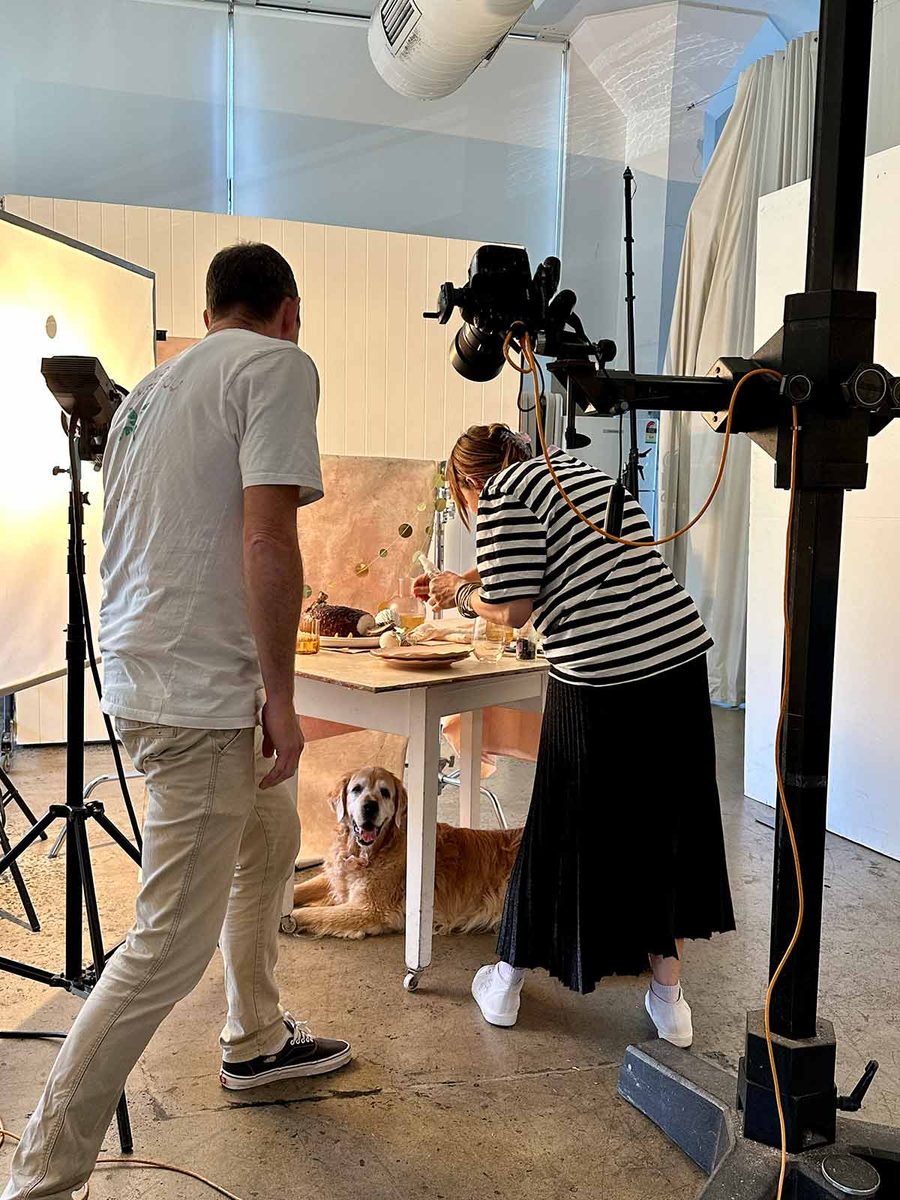
Coming to you in real time! This is Dozer today, at a photography studio for a Christmas special edition of Good Food Australia with the A-team: Rob Palmer (photographer), Emma Knowles (food stylist), Theresa Klein (photo chef). Who ever imaged a discount dog would experience such things!!
I was looking for nutrition facts then realized I don’t really want to know 🤣
So, water eggs flour for the dough. butter and onions to fry. potatoes/cheese filling. Learned from my grandma. Im over 50, a dude. i dont measure.
Hi Nagi, traditionally these are not made with cheddar cheese, but curd cheese or quark. I love them with added browned chopped onions into the filling, with plenty of black pepper. We usually serve them just boiled & topped with extra fried onions or bacon, or fry them next day until extra browned. A side of dipping soured cream is a must for this recipe!
Dear Nagi, I love you dearly and I follow your recpies religiously for quite a few years now. I’m probably the very first European to pre-order your book – I’m only writing it for you to be sure my comment doesn’t carry any malice. I’m sorry, but there is never any cheddar – or other, as we call it ‘yellow cheese’ in Polish – in Ruskie dumplings. You only use quark (or, if desperate enough, cootage cheese) for it. It is also worth noting that ‘Ruskie’ does not mean ‘from Russia’, but ‘Ukrainian’. Best regards, Kamila
I am Polish but have never eat dumplings filled with cheddar cheese . Ruskie filling is potato, white cheese( the best buy in polish shop it caled TWARÓG , this is something like cottage cheese ) also fryed chopped onion need to be added . Then must be gentle mix but not too much. I love pierogi with blueberry filling, strawberry, sweet cheese and meat. My partner is a chief and he is doing the best one!
Unfortunately this dough is not elastic and I can’t stretch it and tears. I would look for a different recipe
I put these in a bag to freeze overnight and make the next day… 90% of them froze together in a big clump and when I defrosted them I was unable to separate them without ruining them. I don’t know if I didn’t flour in between them enough or what but I was truly crushed… 3 hours down the drain… anyway the ones that survived tasted great, especially getting them crispy in the pan. Please don’t make the same mistake as me, make them all in one day or separate them.
Sara – usually when I freeze anything like for example gnocchi – I find it’s best to freeze uncovered and separated on a baking tray – then once frozen (say couple hours) transfer into a ziplock bag. Hope that helps!
I like to freeze stuff by lying them out on a baking tray to poping them into the freezer, once their fully frozen you can chuck them in a bag, it’s never failed me and you don’t have to deal with excess flour.
Best to freeze them flat on the cookie sheet. Once they’re individually frozen, then put them in the bag. This works with anything – even berries.
Freeze on flat surface, try keeping each pierog seperate. Don’t defreost before cooking, just pop frozen ones to boiling water and gently stri every minute to prevent them sticking to the bottom of the pot. Wait until they float and gently simmer for a minute. That’s it!
1. Blanch them first for 30 seconds in hot water.
2. Then put out to cool on a plate or platter covered with baking paper (a must!) greased with oil.
3. Wait until cool.
4. Put in the freezer as they are (on platters with paper and oil) for 90 minutes.
5. After 30min check if they don’t stick to the surface, unstick them if necessary.
6. After 90 minutes you can safely put them in a bag.
After blanching and freezing they need a bit more time to cook. Put them frozen in boiling hot water. Once they flow on the surface give them 5-7 minutes until ready.
I froze my yesterday for today’s supper 🙂
Greetings from Poland 🙂
When freezing the pierogies you do not boil them first you lay them out on a biscuit pan put them in the freezer and then when they’re frozen I put them in Ziploc bags. If you want to use the pierogies in the next few days after you boil the pierogies you scoop them out of the boiling water put them in a bowl with butter and toss it around you keep repeating that the butter helps the pierogies not stick together
Quark is hard to find here in Australia and it’s getting expensive- but danish feta works well as a substitute. Adding some fried small cubes of speck to the filling is also delicious!
You can make these with strawberries and blueberries aswell ( without the butter and onion sauce) and serve with some sour cream and a sprinkle of sugar. Yum!
I can usually find Quark at my local Aldi (in Canberra). Not sure if all their Au supermarkets stock it though. Agree that Danish Feta and cottage cheese make great substitutes!
Hi
I found Quark farmers cottage cheese that is dry and perfect for pierogi. I’m excited to finally have the right cheese. It comes from Latvia and purchased in Balaclava, Melb at Bajer in the Rye! Other cheeses add too much moisture therefore making filling soggy.
Hello Nagi, from my first post of this receipe, I wanted to try your dough receipe. There are so many variations to make this wonderful dish, despite my Baba’s dough receipe, it is either a hit or miss, if I do it correctly or not.
Yours….without a doubt was perfect. It was so easy to roll over the dough and pinch the sides with ease. Despite making thus for 30 years, your dough receipe, is now my go to. Thank you for teaching different ways. Will send photos to your generic email of today’s results. Keep them coming. Hope Dozer is doing well
There were comment regarding the choice of cheese, so if you decide to go with (very accurate) Joseph’s suggestion to use anything that is quark like, adding a pinch of fresh mint to the filling will make a difference.
Took us more than double than the estimated cooking/prep time haha. But it was well worth it! Didnt make any alterations and it was so yummy, glad we doubled the batch!
Don’t despair with time you’ll be able to make them in record time. Been making them for 50 years and I can make a hundred in an hour
very nice recipe the traditional cheese is easy to make just cottage cheese cheese cloth and a cheese press , also I like sautéed in Butter finally diced onion or scallion added to the riced potato. as filling. diff herbs can also added to cottage cheese prior to press.
Just made these, can confirm they are a bajillion times better if you add bacon and fry it in the pan until crispy
I need to make these a day ahead. Do i store them after boiling or boil them the day off? How do i keep them from sticking together?
They are not Polish Pierogi Ruskie!!!!!!We do not use cheddar cheese only cottage cheese. Mashed potatoes+ cottage cheese + black pepper+carmelized onion and pancetta as a filling.
Soooo good. I’ve made them several times. And they freeze fabulously too.
I am Polish and my mom is a pro at making pierogi (Pierogi is already plural… no need for the “s” lol ) (one pierog or two pierogi) I love that you make the dough simple… my mom makes and I usually use water that is boiling… almost too hot to handle to make the dough really soft and pliable. I would also like to add that instead of butter you can use bacon… that is chopped in small pieces and fry it with onions… it gives it really rich flavor… and one more tip… which is my favorite… I usually pan fry my pierogi after they are boiled… to crisp them up a little bit on both sides… to give it a slight crunch… and they are delicious… but as many Poles as there are in the world… we have just as many different variations of making pierogi… fillings and even dough…lol Thank you for sharing your version! And we always flip it … so technically it would be Ruskie Pierogi 🙂 (trans: Russian pierogi… go figure…:)
Love these! I’ve been making them weekly since you posted up the recipe. First time I followed your recipe to the letter. Third time around I subbed in 20g of rye flour in the dough, added 200g of mushrooms finely chopped cooked down in butter with a pinch of thyme to the filling, and added a couple of diced bacon rashers to the onion sauce. OMGeee!!!
Yum! my Ukrainian Grandmother used to make them with farm cheese filling (a type of firm cottage cheese available at European delis). The filling was just the cheese mashed with salt pepper and an egg (similar to how you would use ricotta in italian dishes). Another version was Sourcrout/mince meat. When they were a day old we used to fry the pre boiled dumplings in butter (think Gyoza) and have them with lashings of sour cream, our favorite way to enjoy them. They freeze well after boiling and you can quickly pan fry them for a wonderful quick treat.
My Ukrainian grandmother used mashed potato and sauerkraut. I need to make some..
Over 40 years ago, with flour flying, and our Polish-Canadian friend as mentor, we made a whole day of making perogies, ending with mandarin orange ones for dessert! Reading the comments, it seems like perogies are a touchstone. Made Nagi’s tonight and these are way better than store-bought. Just an observation: my cut circles shrunk quite a bit, but I adapted.