
Considered by many to be the mother of all stews, Beef Bourguignon is a French dish made with beef, bacon lardons, carrots, onions and mushrooms slow cooked in a rich red wine sauce.
For the most magnificent stew of your life, start this 2 days before you plan to serve it, do not shortcut pan-roasting ingredients individually, and use homemade beef stock!

Beef Bourguignon
One of my fondest memories of travels in Burgundy was discovering family-run bistros in small villages that served traditional French fare so incredible, you’d swear you were in a hidden Michelin star restaurant.
And being right in the region from which Beef Bourguignon hails, it was hard to resist ordering this iconic dish time and time again. Every bistro had their secret recipe, and no two were exactly the same.
Except, perhaps, the quality that each of them were to me, the most incredible Beef Burgundy I’ve ever had in my life!.
I just need to add one more to that list though: This Beef Bourguignon recipe you’re reading. It was created with the assistance of a classically trained French chef from Burgundy residing right here in Sydney, Jean-Baptiste Alexandre of Baptiste & Wilson. For a dish this iconic, I refused to just settle for any old recipe.
This Beef Bourguignon is hands-down better than any I’ve made in my life – including Julia Child’s recipe.


What goes in Beef Bourguignon
There are two main components to making Beef Bourguignon:
Red wine-marinated beef; and
Slow cooked stew
1. Red wine marinade for beef
Here’s what you need for the red wine-marinated beef:

Chuck beef – Not all beef is created equal, even when slow-cooked into fall-apart submission! Look for good quality chuck beef, ribboned with fat for the juiciest result.
Also, be sure to either buy BIG pre-cut pieces – as in 4-5 cm / 2” cubes – or a one single piece which you slice up yourself. If you purchase pre-cut pieces that are too small, they will cook faster than the time it takes for the sauce to develop enough flavour;
Pinot noir – Beef Bourguignon is also known as Beef Burgundy, and thus the wine called for is a Pinot Noir – the most famous variety of wine produced in the Burgundy region of France.
Using a lighter style wine might sound unexpected for a hearty stew, but the more delicate flavour compared to bolder wines like Shiraz makes it ideal for using as a marinade so the red wine flavour doesn’t overwhelm the natural beef flavour.
We’re using a whole bottle here. Sorry folks, you’ll need another bottle for drinking!
Thyme and bay leaves – Classic herb aromatics;
Carrot – Just your everyday standard carrots will do fine;
Pearl onions – These small onions are the traditional onions used in Beef Bourguignon but are annoyingly difficult to find here in Australia. I use what’s sold as “pickling onions” which are virtually the same but slightly larger, so I peel an extra layer or two off the surface to make them pearl onion size (~3 cm / 1.2″ diameter).
Alternative: Just use slices of a normal onion. The end result tastes the same, I promise!
2. The stew
And here’s what goes into the stew:

Beef stock – The single biggest variable on which a stew hinges, differentiating a good home-cooked stew and a quality, why-does-this-restaurant-stew-taste-so-damned-good result.
Homemade beef stock trumps store-bought. But if you’re going down the store-bought path, try to opt for a good quality stock from the butcher rather than the cheap mass-produced stuff. The difference I promise is remarkable.
Having said that though, I would never say that this is not worth making with basic supermarket beef stock. It is, oh-so-very worth making!
Bacon – Get slab bacon from your butcher if you can, so you can cut it yourself into big chunky lardons (batons). A proper bite of meaty bacon lardons is part of the awesomeness that is Beef Bourguignon.
If you can’t find slab bacon, try speck (which in Australia seems to usually smoked pork belly chunks). Failing that, normal bacon slices works just fine too;
Mushrooms – Just your everyday normal mushrooms. Cut large ones into quarters, medium ones in half;
Garlic – Flavouring (rare to see a savoury dish around here without it!);
Tomato paste – For a touch of tang, to help thicken the sauce, for flavour and for colour; and
Flour – For thickening the sauce.
How to make Beef Bourguignon
For the absolute best results, start this 2 days before you plan to serve it to allow for:
Overnight marinating of the beef; and
Leaving the finished stew overnight to let the flavours develop even further.
Part 1: Beef marinade
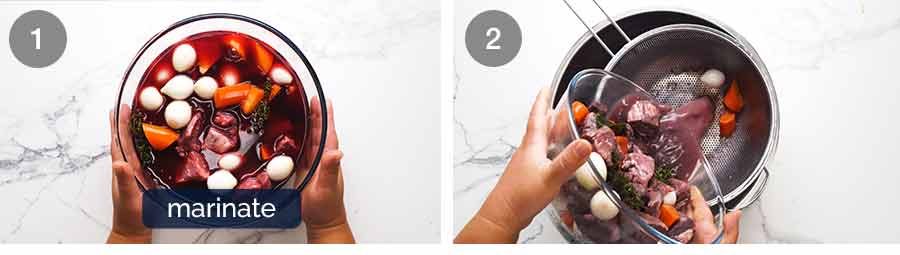
Marinate beef for 24 hours in red wine with the onion, carrot, thyme and bay leaves. This tenderises and infuses the beef with beautiful flavour. I’ve tried it with and without marinating, and marinating is way better. It’s worth it!
Strain and reserve the red wine – we’re going to reduce it to use as the stew braising liquid;
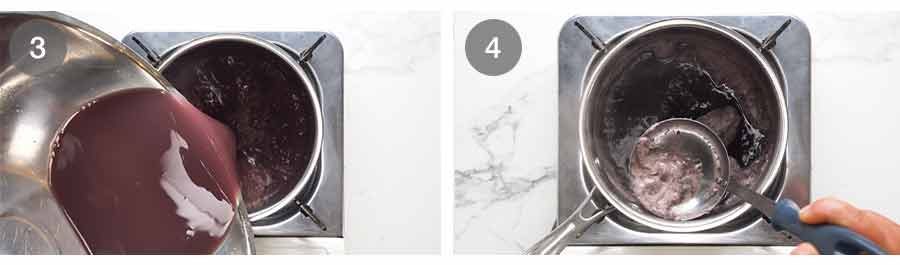
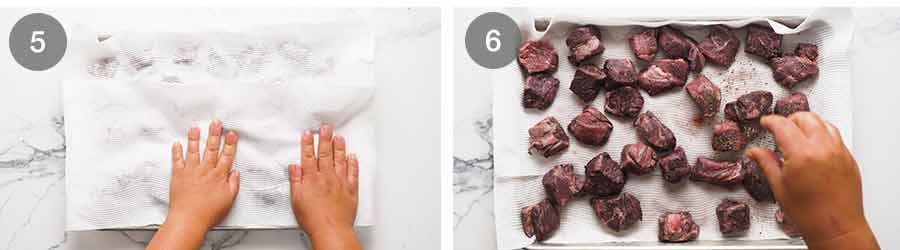
Reduce wine – Pour red wine into a saucepan;
Reduce – Simmer until reduced by half, about 7 minutes on medium high. Skim any scum off the surface using a ladle;
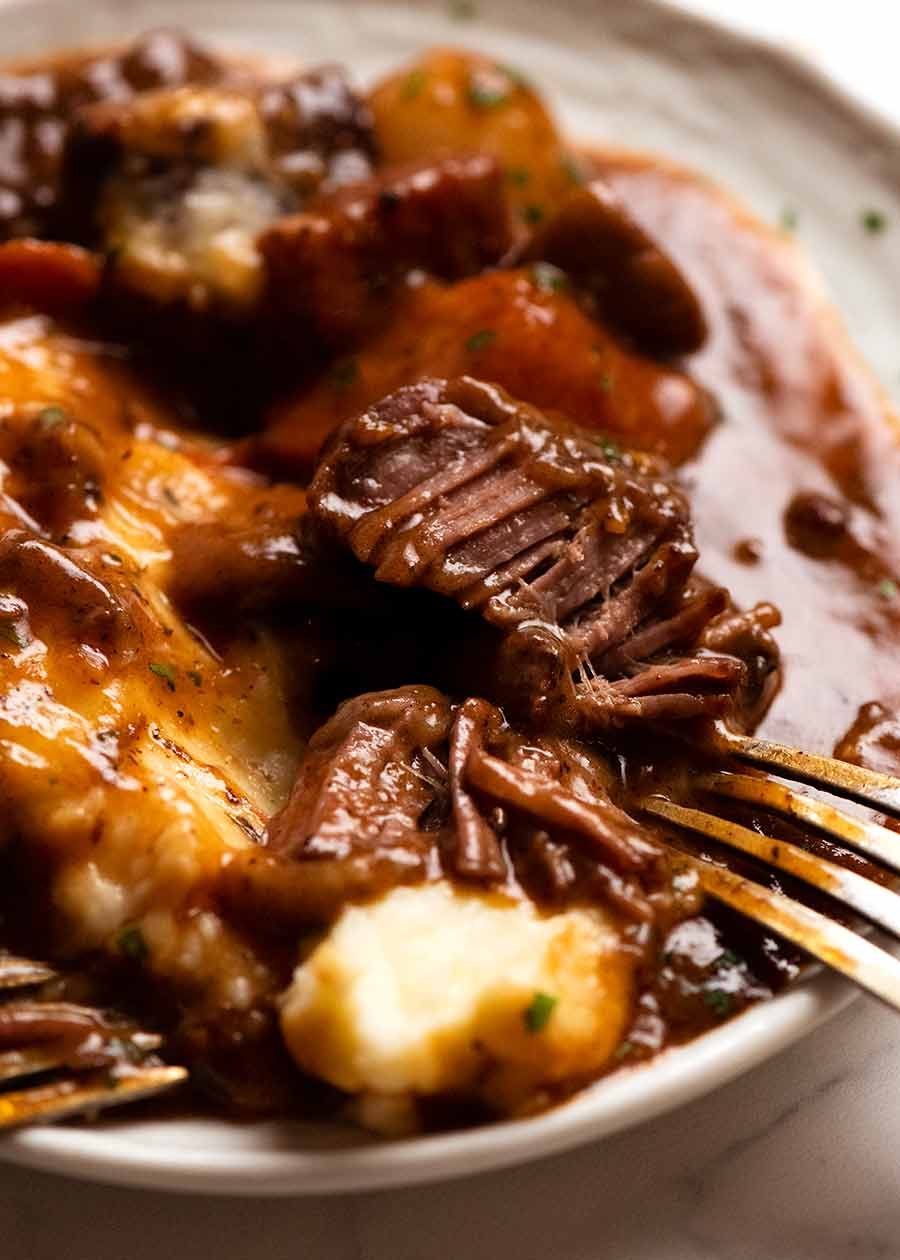
Pat beef dry – Separate the beef from the carrots and onion, then pat dry. Why? Because wet beef won’t brown. Browning is key for flavour!
Season beef with salt and pepper. Ugh, please don’t skip this step. I once did, and even though I was salting the sauce furiously at the end, it just wasn’t the same!
Part 2: Making the stew
It’s well worth taking the time to brown each of the ingredients individually before slow cooking in the braising liquid. The browning adds a depth of flavour you just can’t achieve by dumping everything in at the same time!

Brown beef aggressively all over, because colour = flavour! A very heavy pot like a cast iron pot / Dutch oven works best for this job.
Be sure to use enough oil so the beef browns rather than burns. Work in batches and don’t crowd the pot otherwise the beef will just braise instead of brown.
Once browned, remove into a bowl;
Bacon – Cook the bacon next, to release all that tasty bacon fat which we then use to brown the subsequent ingredients;
Onion next – Just cook until you get some nice golden patches, it’s impossible to make it golden all over due to the shape. Put these in a separate bowl because these get added back into the stew partway though the slow cooking phase;
Mushrooms – Cook the mushrooms until golden, then add them into the same bowl as the onions;
Carrots last – And finally, pan-roast the carrots until you get some lovely colour on them. We add some butter here, because you’ll find that the mushrooms soak up all the remaining bacon fat, but we need some fat to make the roux with the flour in the next step;
Tomato paste and flour – Add the tomato paste and cook to take the raw edge off. Then add flour and cook for a minute;
Add liquid – Slowly add the beef stock while stirring so the flour dissolves easily, no lumps! Then stir the reduced red wine in;
Add beef, bacon, thyme and bay leaves, then give it a good stir and bring to a simmer. Now, it’s ready to slow-cook into fall-apart magnificence!
Part 3. Slow-cooking
This is all about time – and not forgetting to add the onion and mushrooms partway through!

Oven 1 hour – Cover pot then place in the oven for 1 hour at 180°C/350°F (160°C fan). At this temperature, the stew is simmering very, very gently in the oven, like it would on a low stove. I find the oven is easier than stove because you don’t have to worry about the base catching – no need to stir;
Add onion and mushroom then give it a gentle stir;
Return to the oven for another 1½ hours, until the beef is “fall apart tender” – like THIS:
Adjust thickness and salt – At this stage, if the sauce hasn’t reduced enough (ie. too thin) or the sauce is too thick (which can happen if you didn’t use a heavy-based pot), you can adjust it using the stove.
If it’s too thin, just simmer gently on low heat. It won’t take long to reduce and thicken. If the sauce is too thick, add a splash of water then simmer gently to bring it together again.
Also, don’t forget to check if there’s enough salt in the sauce! Taste and adjust as necessary. 🙂
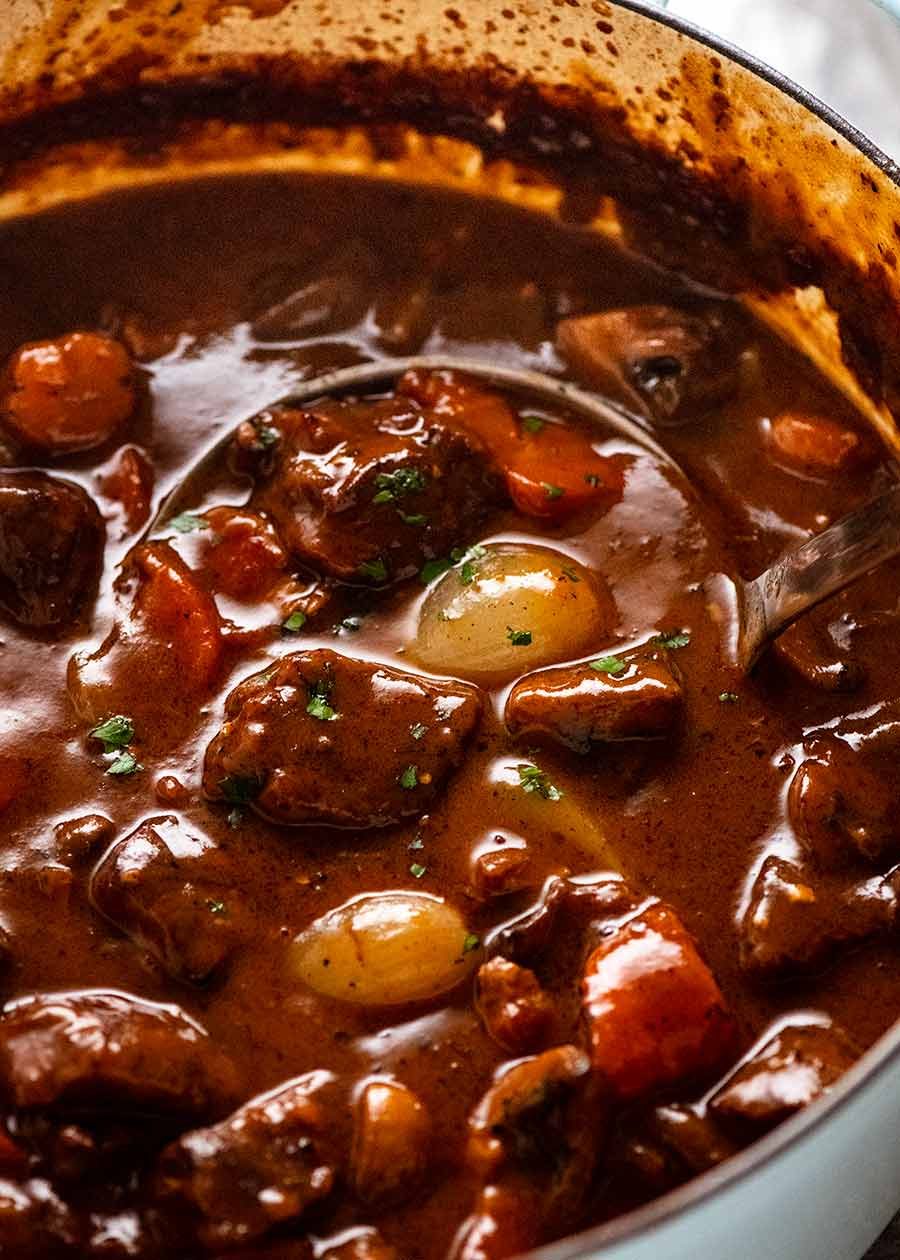
Highly recommended: Leave overnight before serving
As with all stews, Beef Bourguignon benefits greatly if you can leave it overnight which lets the flavours develop further and meld together even better.
Don’t get me wrong, it is sensational served on the day it’s made. But it’s even better the next day!
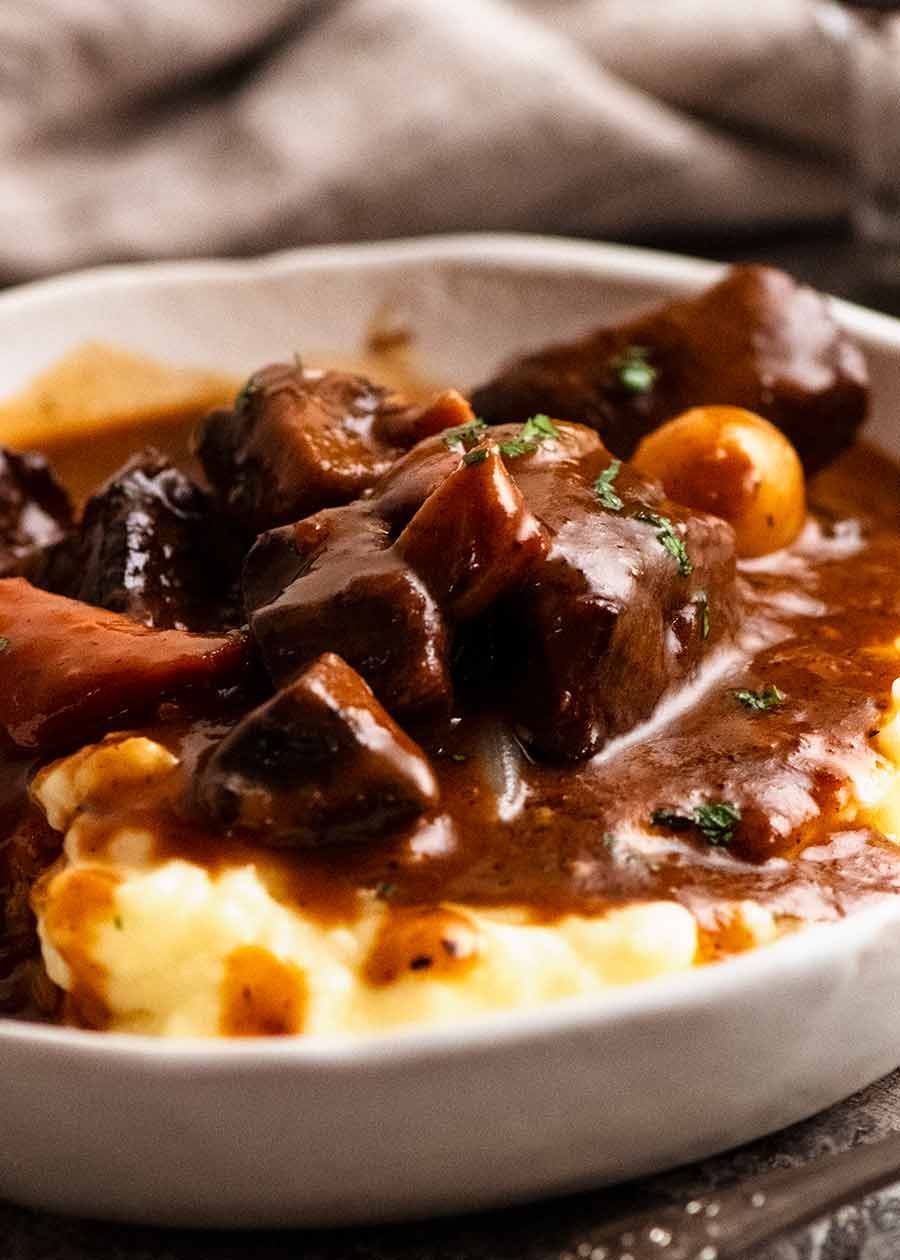
What to serve with Beef Bourguignon
I suppose one could serve this over a short pasta, polenta, or a grain. But for me, I would never contemplate anything other than buttery Mashed Potatoes!
And while I usually offer Paris Mash as an even more luxe alternative, I actually think it’s too rich for Beef Burgundy.
Complete your Burgundy experience with a fresh French Bistro Salad on the side. You’ll find variations of this salad served all over France, for a clean and palate-cleansing side intended to serve alongside hearty mains like this.
Enjoy! – Nagi x
Watch how to make it
Hungry for more? Subscribe to my newsletter and follow along on Facebook, Pinterest and Instagram for all of the latest updates.
Beef Bourguignon (Beef Burgundy)
Ingredients
Beef marinade:
- 800g/ 1.6 lb chuck beef , cut in 4-5 cm / 2” cubes (Note 1)
- 2 large carrots (~300g/10oz), cut on an angle into 4-5 cm / 2” pieces
- 16 pearl onions or small, round pickling onions (Note 2)
- 1 bay leaf , fresh (sub: dried)
- 3 sprigs thyme
- 750ml/ 25 oz pinot noir or other red wine (Note 3)
Browning beef:
- 3 tbsp oil , olive, canola or vegetable
- 3/4 tsp salt
- 1/2 tsp pepper
Stew:
- 200g/ 7oz mushrooms , halved (quarters if large)
- 150g/ 5oz bacon piece , cut into 1cm / 1/2” thick batons (Note 4)
- 50g/3 tbsp unsalted butter
- 3 garlic cloves , minced
- 2 tbsp tomato paste
- 6 tbsp flour , plain/all purpose
- 3 cups beef stock (low sodium) , preferably homemade; otherwise the best you can afford (Note 5)
- 1/4 tsp salt
- 2 tbsp chopped parsley , for garnish
Instructions
Marinate beef:
- Marinate beef: Place the Beef Marinade ingredients in a large, non-reactive ceramic dish or ziplock bag. Marinate overnight in the fridge (minimum 12 hours, maximum 24 hours).
- Strain liquid into a bowl, reserve marinade. Separate the beef, carrots and onion.
- Reduce wine: Pour red wine into a saucepan and bring to a boil over medium high heat. Simmer vigorously, skimming off any impurities that rise to the surface, until reduced by half. Set aside.
Brown beef and vegetables:
- Preheat oven to 180°C / 350°F (160°C fan).
- Dry beef: Line a tray with paper towels, spread beef out, then pat dry with paper towels.
- Season beef: Sprinkle beef with 3/4 tsp salt and 1/2 tsp black pepper.
- Brown beef: Heat 2 tbsp oil in a large, heavy-based, oven-proof pot over high heat. Add 1/3 beef and brown aggressively all over. Remove into bowl, then repeat with remaining beef, adding more oil if needed.
- Fry bacon: Add bacon and cook for 3 minutes until golden. Add to bowl with beef.
- Sauté mushrooms: Add mushrooms and cook for 5 minutes, or until golden. Remove into a new bowl.
- Sauté onion: Add a bit of extra oil if needed, then cook onions for 5 minutes or until there are nice golden patches. Add to bowl with mushrooms.
- Sauté carrot: Add butter into pot. Once melted, add carrot and cook for 3 – 4 minutes until there are golden patches. Add garlic and cook for a further 1 minute.
- Tomato paste: Add tomato paste and cook for 2 minutes.
- Flour: Add flour and cook for 2 minutes.
- Add wine and stock: While stirring, slowly pour in beef stock – this helps the flour dissolve lump-free into the stock. Then add wine and mix until flour mixture is dissolved and mostly lump-free (Note 6).
- Add beef into pot: Add beef, bacon, thyme, bay leaf, 1/4 tsp salt and pepper into the pot, then stir well.
Slow-cook:
- Oven 1 hour: Bring to a simmer, then cover and transfer to oven for 1 hour. (Note 7)
- Mushrooms and onion: Remove from oven, stir in mushrooms and onion.
- Oven 1½ hours: Cover with lid and return to oven for 1½ hours, or until beef is "fall-apart tender".
- Adjust salt: Remove from oven, taste sauce and add salt if needed. (Note 8 – important!)
- Leave overnight (recommended): If time permits, leave the stew overnight before serving because as with all stews, it gets better with time! Reheat gently on a low stove.
- Serve over mashed potato – Essential for mopping up every drop of that amazing sauce!
Recipe Notes:
1. Chuck beef – Look for beef that’s nicely ribboned with fat, as it will be juicier and more tender. Don’t buy pre-cut small pieces, they will cook too quickly before the flavour in the sauce develops. It’s better to buy a big piece and cut your own to size. 2. Pearl onions are very small onions and are irritatingly hard to find in Australia. The closest are pickling onions which are slightly bigger, so just peel an extra layer or two off to make them the right size – around 2.5cm/1″ in diameter. Soak them for 10/15min in cold water, it will soften the skin and will make them easier to peel (use a small knife to assist). You can also just use 2 brown or yellow onions, halved then cut into 1cm / 2/5” slices. 3. Pinot Noir is the traditional wine used in Beef Bourguignon. It’s the red wine that the Burgundy region of France is most famous for, reflecting the origins of this dish which is also known as “Beef Burgundy”. There’s no need to splurge on expensive wine here. Just rummage through the discount bins at your local liquor store. The bottle I used an end-of-bin bottle steeply discounted to $7 (I stocked up!). 4. Bacon Lardons – Biting into a thick piece of bacon is all part of the Beef Bourguignon experience! If you can’t find a slab of bacon to cut yourself, try speck which is similar (and similar fat % too which is key!). Otherwise, just use streaky bacon cut into strips. Bacon is key for sauce seasoning, so don’t skip it! 5. Beef stock quality is the key variable here that will set apart a good homemade Beef Bourguignon from an exceptional restaurant-quality one. Homemade beef stock trumps any store bought. Good quality store-bought from butchers etc. are far better than mass-produced (like Campbell’s here in Australia). Do not use powdered beef stock. It’s frankly inferior to even the packet liquid stock and has no place here amongst all this effort, I’m afraid! 6. Flour lumps – Don’t fret if you have some lumps! They will dissolve during the slow cooking time 🙂 7. Cook method – Oven is best because it’s entirely hands off, no need to stir to ensure base doesn’t catch. But it can also be done on a low stove, lid on, stirring every now and then (take extra care towards the end so the meat doesn’t break apart). Slow cooker: This can work but you’ll need to reduce on the stove at the end to thicken sauce. Slow-cook for 4 hours on low, add mushrooms and onion, then slow cook a further 4 hours. Transfer to pot then simmer (no lid) for 15 – 20 minutes until sauce reduces. I really think it’s just easier to use the oven! 8. Salt quantity required varies drastically depending on saltiness of bacon, homemade vs store bought stock (homemade is unsalted), so always do this at the end and trust your tastebuds. With homemade beef stock, I add another 3/4 tsp salt. With store bought, it’s unlikely you’ll need more salt. 9. Storage – Stew will keep for 5 days in the fridge, and freezes great! 10. Recipe source: Developed with the assistance of a classically trained French chef from Burgundy, Jean-Baptiste Alexandre of Baptise & Wilson. For a dish this iconic, I refused to just settle for any old recipe! Better than the Julia Child recipe I’d been using for years. 🙂 11. Nutrition per serving, assuming 5 servings.
Nutrition Information:
Life of Dozer
Where he’s been positioned while I’ve been bashing out this recipe. Notice how he sprawls across two seats – and also notice how I thoughtfully pushed them together for him. #sucker

3rd time making this, this year and it’s always spot on! Beautiful recipe—time consuming, but still easier and more satisfying than the “traditional” recipe. Love it! Thanks Nagi💙
Delicious! The whole family enjoyed and said restaurant quality depth of flavors. Definitely one to repeat!
This recipe is a keeper! I followed the recipe exactly, except I used a new bottle of wine in the gravy (and dumped the wine the meat was marinading in down the drain). That’s just me being me. The taste was great, glad I doubled the batch and froze 1/2. Thank you Nagi!
Sooooooo delicious 😋 I made it in the slow cooker because I was at work, but followed all the other instructions. It was the yummiest beef stew I have ever had 😊
This tastes divine! It takes a lot of time to make, however the effort is worth it. The only thing I changed was that I used a second bottle of wine for the gravy and dumped the wine that I had marinated the beef in. That’s just me being me. Terrific recipe. This is a keeper, Thank you!
Followed recipe exactly, even had authentic pearl onions from my local Whole Foods. Never marinated in wine overnight, but y’all – do this! Most amazing beef ever. Could not wait until next day for first serving – had a sample taste and BAM – dinner is served. What a treat. Have diabetes, so subbed mashed potatoes with a hunk of sourdough to get all the gravy. This recipe is going in my permanent library. Thanks, Nagi!!!
Made this for new years…it was a huge hit!!! Made a double batch of meat and took the time to properly sear the chunks in small batches. It took a while. The wine from the marinade was gross when I was reducing it (foamy, cloudy) so I pitched it and used a fresh bottle of wine, reducing it as I went. I also used a bit of the red wine to deglaze the Dutch oven after searing the beef and veg as I wanted that deliciousness in my stew. I was a bit worried about the flavour when I first made it, but I let it sit for a day before gently reheating in the oven. I only added the mushrooms at the reheat stage. It was incredible!!! My guests loved it so much! I will def make again. Thanks so much for this recipe!!!
Flank steak is good for this recipe. Shank is the best. I leave the bone intact, sear it, and toss the entire thing in the pot. Towards the end, I pull out the beef and slice it up. It is perfection!
Outside of the round primal, chuck is the lowest quality. It is okay for cheap stews, but not for this delicious recipe. Just say no.
Other than the beef choice, this is a solid recipe. Thanks.
I’ve made this recipe twice. The first time, I marinated the chuck roast for 24 hours. The second time I did 12 hours. There is a definite difference in how much wine you taste in the beef 12 hrs vs 24 hrs. 24 hrs WINS hands down. The slight wine taste when you bite into the beef is just feels sooo luxurious. It’s the one thing that REALLY sets this apart from a regular pot roast.
Anyways, this is the BEST beef bourguignon recipe out there. Better than Julia Child’s and Anthony Bourdain’s recipe. Probably one of the best things I have ever tasted.
I’m going to make this for xmas – it’s much less stressful than cooking a roast, I’ve randomly got a load of braising/stewing steak in the freezer, and I don’t like turkey anyway (it’s chicken’s crappier cousin the rest of the year…).
Anyway, I can’t get the right kind of bacon round here so I’ll just use streaky and hope for the best. But is it supposed to be smoked bacon or unsmoked? I’m worried that smoked will be overpowering, but I’m also worried that unsmoked will be a bit pointless. What does anyone else use?
I made this recipe for a Christmas celebration with friends and everyone absolutely loved it. There’s quite alot of prep time involved, so definitely get started a couple of days before, but I followed every single step and the result was a glossy, tender, full flavoured dish that I was so happy to serve.
This was a lot of work! I made a double batch for Thanksgiving, so of course it was more time consuming, but it did take a very long time. for the prep on the second day. While still a 5 star recipe, I couldn’t get mine to thicken. I probably did not reduce the wine enough. And at the end, while I was trying to get the stew to thicken, I overcooked it. The meat was too done, and I should have used another thickening method and done it earlier. Oh well. It was still a great stew, but I’ll have to make a notation about this in my copy.
That happens to me a lot more often than I like to admit. I make sure to always have cornflour (cornstarch) stashed in the cupboard. Mix some with a little cold water then add to the sauce & simmer til it thickens. It’s the easiest way to save a thin sauce and it doesn’t affect the flavour or go lumpy.
That happens to me a lot more often than I like to admit. I make sure to always have cornflour (cornstarch) stashed in the cupboard. Mix some with a little cold water then add to the sauce & simmer til it thickens. It’s the easiest way to save a thin sauce and it doesn’t affect the flavour or go lumpy.
What a perfect recipe for a cold winter weekend. I made this and my wife said it’s “perfection!” The best sauce/gravy she’s ever had.
Thanks for sharing the recipe.
Question, wouldn’t it be better to salt the marinade instead after browning the beef? That way the salt can penetratw the beef thoroughly and seasin rhe vegetables as well.
Probably doesn’t make a whole lot of difference. Salt will wash off the surface of the meat into the sauce anyway and make its way into the veg from there.
Had left over Pinot Noir from wine tasting in a boutique winery. He was going to pour 6 bottles down the sink. I made this instead. Delicious and a great recipe. I added celery. Note: the receipt doesn’t say when to add the garlic, but I did it with the tomato paste. It got the seal of approval from the fussy bodies in my house. Served with boiled Dutch cream potatoes and sautéed greens from my vege garden.
The stew taste great but the beef tastes like wine after marinating overnight.
It’s kind of supposed to.
Personally, I’d be more worried about the wine tasting of raw meat… 😉
I made this tonight-it’s been on my “Must make bucket list” for a long time! Had a French themed dinner menu and this was the best! Everyone loved it and it was incredibly delicious! A lot of work but well worth it!! Followed Nagi’s recipe to the T and it was Tres Magnifique!!
I have not made this yet but have a question. If I make it a day ahead what is the best way to reheat it?
Just put the pan on the hob at a low heat until it’s all heated through. Although If you want to reheat individual servings it’s probably easier just to nuke it.
Remembrance Day 1970 is the day my bff introduced me to my husband and her boyfriend. We were married eighteen months later three weeks apart! I made the Beef Burgundy and it was a great hit for our fifty five year celebration! Thank you.
This IS THE best beef dish I have ever tasted. Game and life changing if you appreciate food done to perfection. We’ve made it 3 times in a month now making filo pastry pies too to scratch our urge! All your recipes are superb and this is no exception and worth the wait! Many thanks to you for sharing.